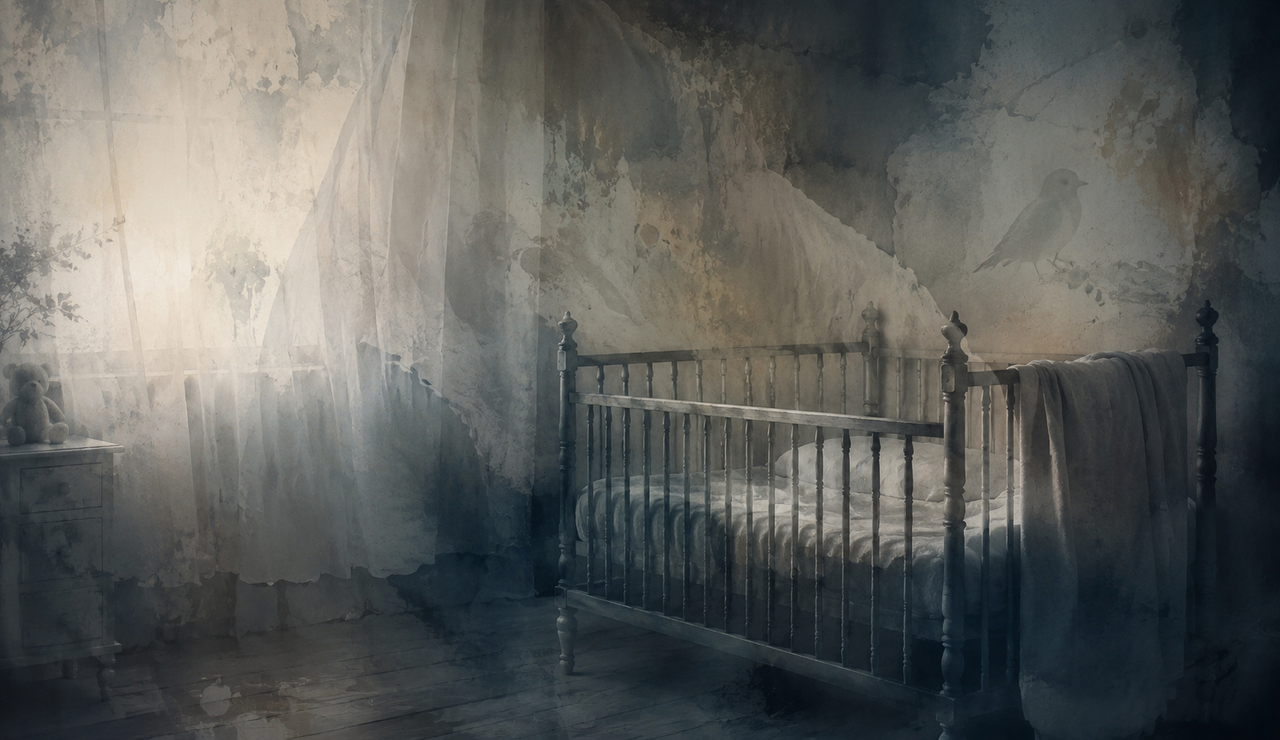
The Empty Cot: Grief, Guilt, and the Ghost in the Nursery
The Empty Cot: Grief, Guilt, and the Ghost in the Nursery
Mandy did not take her coat off.
She sat in the therapy room with it buttoned to the throat, though the room was warm and rain had darkened the shoulders. Her hands were folded in her lap with a care that did not look peaceful, as though even her own body had become something she had to manage.
For three months she had come every Tuesday at six. She was usually early. Sometimes twenty minutes early. She would sit in the waiting room with her phone in one hand and a bottle of water in the other, reading the same message more than once, not replying, and then locking the screen again as though the phone itself had accused her of something. That evening, for the first time, she was late. Only seven minutes, but Mandy apologised three times before she sat down.
“Angel wouldn’t let me leave,” she said. “She was crying again. Gareth had her, but she kept reaching for me. Proper screaming. Like someone was hurting her.” Her voice dropped. “No one was hurting her.”
She described the nights without looking for sympathy. Angel would not stay in her own bed. She would not let Gareth settle her. If Mandy went to the toilet, Angel stood outside the door crying as though a locked bathroom had become another kind of disappearance. “She’s three,” Mandy said. “I know she doesn’t understand what she’s asking from me.”
She said it quickly, before any reassurance could reach her. Then came the part she had brought with her and had perhaps been trying not to bring. “I shouted this morning.”
“What did you shout?”
Mandy’s mouth moved once before the words came. “I told her to stop clinging to me.”
Outside, a car moved through the wet street. The sound came and went.
“She just stood there,” Mandy said. “In those little unicorn pyjamas she likes. Hair stuck to her face from crying. And then her arms went down.” She paused. “That’s what did it. Not the crying. The arms. She just dropped them, like she knew.”
“Knew what?”
Mandy turned to him with the faint impatience of someone being asked to explain the obvious. “That I’m horrible.”
The verdict was familiar in its shape, even if the detail was new. Mandy often spoke as though the case against herself had been decided before any evidence was heard. Not I did something horrible. Not I was tired. Not I frightened her. Something older always seemed to be waiting beneath the incident, ready to gather it in.
I am horrible.
I am wrong.
There is something bad in me.
She said Angel would be better off with Gareth. Then, after a moment, that Gareth would be better off too. When he asked if she meant with her gone, her eyes moved to him quickly. “I don’t mean dead.”
“I’m glad you told me that.”
“I don’t,” she said. “I mean sometimes I think it would be easier for them if I wasn’t there. If I went somewhere. My mum’s. A hotel. Anywhere. Then I couldn’t keep doing this.”
“Doing what?”
Mandy seemed almost confused by the question. “Ruining them.”
That was how she spoke of grief. Not as something that had happened to her, not even as something she carried, but as something that leaked from her into other people: into Gareth’s careful face, into Angel’s sleep, into the rooms at home. Grief, for Mandy, had become less an experience than a contamination.
“You sound very certain that being close to you harms them.”
“It does.”
When he asked what told her that, she answered without hesitation. “My daughter is scared of me.”
“Angel is frightened when you leave.”
“That’s the same thing.”
“I’m not sure it is.”
For a few seconds, Mandy seemed to have nowhere to put that. The silence pressed on her from inside until something gave way.
“It’s a year on Friday,” she said.
She had been approaching the date for weeks. Sometimes it had appeared only in fragments: a supermarket aisle full of newborn clothes, a letter from the hospital, Angel asking a question at bedtime and then forgetting the answer before Mandy could survive giving it. Now the date itself had entered the room.
He repeated only the day she had given him.
“Friday.”
Mandy did not answer straight away. She still struggled with the name. Not because she had forgotten it, but because saying it made Lucy too present and not present enough at the same time.
“Since Lucy,” she said.
“Yes.”
“Since Lucy died.”
For a while, neither of them spoke.
“It was a birth,” she said. “That’s what everyone called it at the hospital. Labour. Delivery. Birth.” Her face changed slightly. “Like something arrived.”
No answer came too quickly. Mandy seemed to hear her own words before anyone else could touch them. “She did arrive,” she said, and after a moment added, “She was real.”
“Yes.”
“I need people to remember that.”
“Lucy.”
“Yes. Lucy.”
The name seemed to stay after she had said it.
“She lived for eleven minutes.”
Mandy drew a breath, but it did not settle her. “Gareth says it might have been longer. He says time was strange and nobody was watching the clock properly. But I know what they wrote down. Eleven minutes.”
“You were still being treated then.”
“They were trying to stop the bleeding.”
He did not ask for more detail. There are questions that serve curiosity more than the person answering them.
“They worked on her first,” Mandy said. “Gareth says he could see them around the little cot with the lamp over it. I was in the same room, but I wasn’t with her.”
The words seemed to cost her something.
“When they stopped, they asked if he wanted to hold her. He says she was still warm.”
That was the sentence that seemed to hurt her most. Not only that Lucy had died, but that Lucy had lived briefly in the same room while Mandy was elsewhere, separated from her by blood, urgency, bodies moving around them, voices lowered but not calm.
“They brought her to me later,” Mandy said. “Wrapped up. Clean. Like they’d made her ready for someone else’s memory.” She had held her then. What she remembered first was not a face or a sound, but weight. “She was lighter than she should have been.” After that she spoke more factually, which made the words no easier to hear. “She was tiny. I knew she would be. Twenty-eight weeks. Nearly twenty-nine. Everyone kept saying babies can survive that now. They said there was a chance.”
“And then?”
“And then there wasn’t.”
The sentence needed room around it. Mandy seemed to know this too. She did not rush on, but sat with the misery of having said something so final that there was nowhere immediately to go.
At last she said, “I should have gone in earlier.”
This was not new, but that evening it came with a different weight. Everyone had told her there was nothing she could have done: Gareth, her mother, the midwife afterwards, the consultant, the woman from bereavement. “They all say it like they’ve been given the same leaflet,” she said.
“And what do you say?”
“I waited.”
The words were plain. Almost calm.
She had felt different that morning. Not pain exactly, not at first, but wrong; heavy; as though her body knew something before she did. Gareth had already left for work, and Angel was at the age where every ordinary task could become a negotiation. Mandy had already been in twice because she thought something was wrong, and twice she had been told everything was fine. “I didn’t want to ring him over nothing,” she said. “I was afraid of being dramatic.”
The word troubled her as soon as she said it. “That sounds stupid now.”
“I don’t think it sounds stupid.”
“You would say that.”
“I might. But I also mean it.”
Mandy let out a small breath, not quite a sigh. She had told herself to wait and see. Have a shower. Get Angel dressed. See if it passed. “Angel wanted toast. Then she didn’t want toast. Then she cried because I cut it wrong. It was just a normal morning. That’s what I hate. It was normal. There was washing on the stairs. There were crumbs everywhere. Peppa Pig was on too loud. And Lucy was in trouble while I was wiping jam off the table.”
Her speed had carried her to the end of the sentence. Once there, she seemed stranded by it.
“Mandy.”
She shook her head. “No. That’s what happened.”
“It is what you fear happened.”
“It is what happened.”
He stayed close to the sentence rather than away from it. “You waited.”
“Yes.”
“And because you waited, you believe you harmed her.”
“No.” Her voice hardened. “I killed her.”
There was no shock in her face. Only recognition, as if the sentence had finally been said in its proper form.
“I want to be very careful,” he said. “I don’t want to take that away from you too quickly.”
“People keep trying.”
They told her it was not her fault. When they did, she wanted to scream. They had not been in her kitchen; they had not felt what she felt and ignored it. The word ignored seemed to carry more than accusation. It carried the image of Lucy trying to reach her from inside the ordinary morning and Mandy failing to answer.
“You feel you ignored Lucy.”
“I did ignore her.”
A longer silence followed.
“I was tired,” Mandy said eventually. “That’s the worst part. I was so tired of being pregnant. I loved her, but I was tired. My back hurt. I couldn’t sleep. Angel was waking up every night. Gareth was trying, but he didn’t really understand what it felt like to be needed all day and then kicked from the inside all night.” She stopped. “That sounds horrible.”
“It sounds honest.”
“No. It sounds like I didn’t want her.”
He asked whether that was what she believed, and Mandy did not answer.
“I remember standing in the kitchen,” she said, “holding the side of the counter. Angel was crying because I wouldn’t pick her up. I couldn’t. I felt too heavy. Too full. And I thought—”
This time he did not help her finish.
“I thought, I just want this baby out of me.”
Mandy covered her mouth, but only after the words had left her. “There,” she said. “That’s it.”
He asked whether she meant the thought, and she corrected him. “The truth.”
“A thought can feel like the truth when it arrives at the worst moment.”
“You don’t understand.”
“Tell me.”
“I wished it. Then it happened.”
He repeated it carefully, not as an agreement. She had wished for the pregnancy to be over. Mandy would not allow even that distinction. “I wished her away.”
“Is that the same thing?”
“To me it is.”
“Then perhaps that is where we need to stay for a while. With the difference between being exhausted and being destructive.”
Mandy seemed to consider this as if he had placed something unfamiliar in front of her. “I don’t know how to separate them.”
“No. Not yet.”
The cot came next, though neither of them had mentioned it. Perhaps it had been there all along, a quiet piece of furniture in the back of the session.
“It was already up,” Mandy said. “Gareth built it a few weeks before. I told him it was too early, but he was excited. One afternoon, while I was picking Angel up from nursery, he put it together and waited for me to come home.”
She paused.
“He took me into the baby’s room like he’d done something wonderful.”
The thought seemed to catch on something.
“Angel kept climbing into it even though we told her not to,” Mandy said. “She said she was testing it.” For the first time, her voice carried something almost like the memory of amusement, though it vanished as soon as it appeared. “She used to say, ‘Baby bed ready.’ Over and over. Baby bed ready.”
For a moment, the room seemed occupied by a child’s ordinary expectation.
Mandy had bought tiny sleepsuits, too many of them, smaller than anything Angel had ever worn. She kept folding them and putting them in the drawer, then taking them out again because she thought they might get dusty. Gareth had laughed gently and told her Lucy would not care if her sleepsuits were ironed. “I was happy that day,” Mandy said.
“That feels difficult to remember.”
“It feels like evidence against me. Because if I loved her properly, I would have gone in.”
The word properly altered the direction of the session. The therapist did not seize it, but he did not let it pass. “What kind of love are you imagining when you say that?”
Mandy frowned.
“A love that never gets tired?” he asked. “Never feels irritated? Never wants relief? Never misreads danger? Never waits?”
“A mother should know.”
“A mother should know everything?”
“When something is wrong, yes.”
He was quiet before he asked the next question. “Did your mother know everything?”
The question reached her before she had prepared for it.
“Suzie,” he said. “When you and Maple were babies.”
At her sister’s name, Mandy became still. “I don’t remember Maple. I was a baby. I only know what Mum told me.”
What her mother had told her came in phrases Mandy seemed to have carried since before she could examine them: Maple was delicate. Mandy was strong. Maple had chest infections, hospital stays, a little cry like a kitten. Maple had died at nine months, or ten, depending on how her mother told it. Mandy had always hated the nearly in nearly ten, as though the extra weeks mattered and did not matter at the same time.
“People used to ask if I remembered her,” Mandy said. “Do you remember your twin? As if babies sit there making memories for later.”
“You don’t remember her, but you grew up with her there.”
“In the photographs.”
There had been one photograph on the mantelpiece when Mandy was little: Maple in a white cardigan, Mandy beside her on the same blanket. Everyone said they looked identical, but Mandy could never see it. Maple looked softer somehow, less here. Her mother kept the silver frame clean even when everything else in the house could be left untidy. If anyone moved it, she noticed.
“And your photographs?”
“There were some. In albums.”
He did not need to say the difference loudly. Maple was on the mantelpiece. Mandy was in albums.
“She was the baby who died,” Mandy said eventually. “That makes people careful.”
“And you were the baby who lived.”
Her face changed, not with surprise exactly, but with the discomfort of hearing something unnamed come too close.
“Mum never said that. She wouldn’t. She loved me. She wasn’t a bad mum.”
“No,” he said. “I don’t hear you saying she was.”
Mandy seemed relieved, then almost suspicious of being relieved. She did not want anyone to think her mother was awful, because her mother had already lost a baby. The sentence changed the atmosphere. Mandy was no longer speaking only about her mother. She was speaking from inside the place where grief could make other people untouchable.
Her nan had once said, “Suzie never came back properly after that baby died.” Mandy had heard it from the kitchen doorway, unseen.
Not after Maple. After that baby died.
Mandy repeated the phrase more quietly: that baby. She had hated it, and now she heard herself doing the same thing with Lucy.
“Lucy,” he said.
Mandy closed her eyes briefly. “Lucy.”
The name entered the room differently now, less as a fact than as someone being allowed to remain.
Her mother’s absence had not always looked dramatic. It had often been quiet: a kitchen table, a cigarette, the back door open in winter, a mother present in body and unreachable in every other way. Mandy would come in from school and know before her mother spoke that she had lost her for the day. She made herself something to eat, watched telly, went upstairs. She was used to it.
“And Angel?” he asked.
Mandy understood before he said more. The irritation came first, then the fear underneath it. Angel cried when she felt she had lost her. She followed Mandy from room to room, wanted to be picked up, said Mummy stay at night until the words became less a request than a small repeated alarm.
Gareth thought Angel was frightened because of what had happened: because Mandy had gone into hospital and come home different, because everyone had cried, because nobody had been able to explain death to a three-year-old without turning it into another kind of absence. “He says she doesn’t understand death,” Mandy said, “but she understands gone.”
There was probably truth in Gareth’s explanation, but it did not reach the place Mandy was speaking from. Angel screamed when Mandy left the room, and sometimes Mandy felt the screaming was not fear that she might disappear, but recognition that some part of her already had.
“It’s like she knows,” Mandy said.
“Knows what?”
“That I’m not really there.”
He took that in.
“Not gone from the house,” he said.
“No.”
“But gone from yourself?”
Mandy was quiet.
“Yes,” she said. “That.”
She described Angel bringing her things: books, dolls, bits of Play-Doh stuck to her fingers, all held out like offerings. Sometimes Mandy looked at her and felt nothing. Then she corrected herself quickly. Not nothing. Too much first, then nothing. Fear first, then the shutting down.
If she picked Angel up, Angel clung. If Mandy sat beside her, Angel climbed onto her. If Angel came into the bed, she lay right against Mandy, like she was trying to get back inside her skin. Mandy heard the horror of that image after she had said it. It sounded frightening, he told her. Mandy said it sounded horrible, because Angel was her daughter and she should want her close. “Part of you does,” he said. That, Mandy said, was worse. “Because then I can lose her.”
The answer returned them to Lucy before either of them named her again.
When Mandy had found out Lucy was a girl, she had pictured the two sisters together: matching pyjamas, little pink clips in their hair, Angel telling Lucy what to do. Gareth had been happy either way, but Mandy had wanted another girl. “I let myself want it,” she said.
“And wanting it now feels dangerous?”
“It was dangerous.”
He did not answer that directly. “When Lucy died, did it feel like something terrible had happened, or like something terrible had been revealed?” Mandy took time with the question. He wondered whether Lucy’s death had felt as though it proved something about her.
Her voice was low. “That I’m not meant to have things. Good things. People. Babies. A family. Anything that stays.” When he asked about Maple, her face altered again. “She didn’t stay,” she said. Then, after a moment, “But I did.” There it was. Not fully thought, perhaps not even fully said, but present enough to change the room.
Mandy seemed suddenly younger, not in expression but in uncertainty, as though she had come upon a door in her own mind and could not tell whether it had always been there. She remembered something her mother had said when Mandy was pregnant with Angel. Mandy had admitted she was frightened of becoming a mother, frightened that she would not know what to do. Mandy thought her mother had meant to help.
“You were always the strong one,” she had said. “Maple was the one who needed me.”
The line seemed to repeat itself without anyone speaking.
When he asked what she heard in her mother’s sentence, Mandy said, “That Maple got her.” Her mother. And Mandy, by implication, had only got to live. She seemed to hear it only after saying it. “I don’t mean that. That’s awful.”
“It may be awful,” he said. “That doesn’t mean it isn’t part of what you have carried.”
Then the tears came. Quietly at first, and then with a force she seemed to resent but could not stop. “I didn’t do anything to Maple,” she said. “I was a baby. I couldn’t have.” He agreed quietly.
But her mother looked so sad in all the photographs after Maple died, Mandy said. In the ones with her. Like she was holding the wrong one. He repeated the phrase, and Mandy covered her face for a few seconds before lowering her hands. “And then Lucy died,” she said, “and I thought, there it is.”
The proof, she meant. Not only that she had been the wrong baby, but that she was wrong full stop. He said her name, not to stop her, but to keep her near enough to hear him.
“Mandy.”
She listened.
“You seem to have had to make yourself the reason for things no baby, and no mother, could fully control.”
Mandy could only return to the fact that she had waited. He did not try to remove that. Yes, she had waited, and they would need to think about that carefully. But waiting was not the same as wanting Lucy to die. Being tired was not the same as destroying her. Surviving Maple was not the same as taking her place.
The words did not comfort her. They seemed too distant, as though each one had to cross water before it could reach her. When she said she did not believe him, he did not press. There were truths that became useless if pushed too hard. “Then perhaps today we don’t need you to believe it. Perhaps today we only need to notice how long you have believed the opposite.”
Mandy closed her eyes. They were damp, but she was no longer fighting the tears in quite the same way. Outside, the rain continued. Inside, neither of them moved to end the silence too quickly.
Eventually, she asked what she was supposed to do with all of it: Maple, Lucy, Angel, her mother, herself. It all just sat there, she said. Naming it did not make it smaller.
“No,” he said.
A faint irritation came into her face. It was not much, but it had more life in it than the flat certainty with which she usually condemned herself. She had come because she was hurting her child, not because she wanted a history lesson in pain.
“You came because you are frightened you are hurting her.”
“I am.”
That morning she had shouted, and Angel’s arms had dropped. Mandy did not need to be persuaded that it mattered. It had hurt her. Perhaps that was part of what she had not been able to use.
“You are afraid there is something dead in you,” he said. “Something dangerous. But you saw Angel’s face. You noticed her arms. You are here speaking about it.”
“That doesn’t make me a good mother.”
“No.”
The bluntness steadied her more than comfort might have done.
“It does not make you a bad one either.”
The clock moved quietly on the wall. Mandy did not answer, but her thoughts had already moved towards home. Angel would still be awake when she got back. Gareth would be in her bedroom, trying to keep his voice soft through the fourth reading of the same story, pretending he was not listening for Mandy on the stairs. She could picture the room before she entered it: the low lamp, the duvet pushed to one side, Angel’s cheeks hot from crying, her small body waiting for the sound of Mandy coming closer.
“What usually happens?”
“Gareth tries to settle her. I stand outside the room.”
“Outside Angel’s room?”
“Yes. Sometimes I tell myself I’m letting him manage it. Sometimes I know I’m hiding.”
If Mandy went in, Angel wanted her to stay. The phrase had become part of the night: Mummy stay, Mummy stay, no longer only a request but a small repeated alarm.
“The doorway has become a difficult place,” he said.
“It’s just her bedroom.”
He did not correct her.
“No,” she said after a moment. “It isn’t.”
Then, without warning, another thought arrived. “The cot’s still in the house.”
It was in the loft. Gareth had taken it down months ago because Mandy could no longer bear walking past it. The room had become Angel’s playroom again in practical terms, but not in Mandy’s mind. The cot had moved, and still it had not gone.
“No,” Mandy said. “It hasn’t gone.”
Angel still called it the baby room. Sometimes she stood in the doorway and said, “Baby bed?” as though asking where it had gone. Then a minute later she wanted biscuits, or Peppa Pig, or her wellies on the wrong feet.
“I hate that,” Mandy said.
“That she moves on?”
“That she can go from Lucy to biscuits like that.” She stopped. “Then I hate myself for hating her.”
He did not soften it for her. Angel was three. She remembered in pieces. Mandy remembered everything: the hospital, the blood, Gareth’s face, the way everyone spoke quietly, the little hat they had put on Lucy, the cot. Angel knew there was meant to have been a baby, but she could not hold Lucy in the way Mandy did.
“You hate her for forgetting because you cannot forget.”
The tears returned, but this time they came without the same resistance.
“What am I meant to say when she asks?”
“What have you wanted to say?”
Mandy was silent for a long time. “That Lucy was real. That she was her sister.” The last sentence cost her most. “That I wanted her.”
He did not make more of it than she could bear. “That feels important.”
“I don’t know if I can say it. She’ll ask why, and I won’t know.”
“Perhaps not knowing does not have to mean disappearing.”
Mandy received this without answering.
The sentence did not forgive her. It did not remove the year, or the hospital, or the eleven minutes, or Gareth holding Lucy while Mandy was being kept alive somewhere else in the room. It did not bring Maple back to Suzie, or Lucy back to the room where the cot had once stood. But it gave Mandy something different from accusation to hold.
Lucy’s mother.
Not Lucy’s murderer.
For now, that was as much as she could carry.
When the session moved towards its end, Mandy did not stand straight away. For a moment, she seemed to hear the house before she had returned to it: Gareth in Angel’s room, careful and tired; Angel in bed with her blanket pushed up under her chin; the small voice from the dimness.
“Mummy stay,” Mandy said.
This time, the words did not sound only like a demand.
“I could go in,” she said. “Not promise all night. Just sit by the bed for a bit.”
He did not turn it into a solution.
At the door, Mandy paused with her hand on the handle. “She might still cry.”
“She might.”
Mandy nodded once, not in agreement exactly, but as if she had understood that crying did not have to mean she had destroyed something.
Then she opened the door and left.
Psychodynamic Reflections
Mandy’s grief is not only grief. It has become organised around guilt, self-accusation and the belief that something in her is dangerous to those she loves. Lucy’s death is not experienced simply as a devastating loss, but as evidence. Evidence that Mandy waited too long. Evidence that she wished the pregnancy away. Evidence that she is the kind of mother who fails to respond when her child most needs her.
This is what makes Mandy’s suffering so difficult to reach. The facts of what happened are terrible enough, but Mandy is not only trying to survive the death of her baby. She is trying to survive what the death has come to mean about her. Lucy’s eleven minutes of life become organised around a single unbearable conclusion: I killed her.
Freud’s distinction between mourning and melancholia is useful here. In mourning, the world feels emptied by the loss. The person who has died remains loved, longed for and painfully absent. In melancholia, Freud suggests, something of the lost object becomes drawn into the self. The pain turns inward. The accusation no longer says only, I have lost someone. It begins to say, I am bad. I am guilty. I am the one who deserves punishment.
Mandy’s internal world carries this melancholic quality. Lucy is not only dead; Lucy has become an accusing presence inside Mandy. Every detail from the morning of the birth is drawn into the case against her: the toast, the jam, Peppa Pig, the decision to wait, the fear of being dramatic, the thought that she wanted the baby out of her. Ordinary maternal exhaustion is transformed retrospectively into murderous intent.
This is why reassurance cannot easily reach her. To tell Mandy “it wasn’t your fault” may be factually true, but it does not touch the psychic organisation of her guilt. The guilt is not simply an error in reasoning. It is a structure that gives meaning to catastrophe. If Mandy caused Lucy’s death, then the horror has an explanation. A cruel one, but an explanation nonetheless. To surrender the guilt might mean facing something even more terrifying: that something unbearable happened and could not be controlled.
Klein’s work on guilt, ambivalence and the depressive position deepens this understanding. Mandy’s guilt is not only rational guilt about having delayed. It has an omnipotent quality. Her tiredness, irritation and momentary wish for relief are felt as though they had actual destructive power. In Klein’s language, loving and hateful feelings towards the object can become dangerously fused in phantasy. To feel frustration towards the baby can feel equivalent to having attacked the baby. To wish for the pregnancy to be over can feel equivalent to wishing Lucy away.
Mandy’s line — “I wished it. Then it happened” — captures this collapse between thought and act. She cannot yet separate psychic reality from external reality. The thought becomes the crime. The wish becomes the weapon. The death becomes proof that her inner aggression was real and lethal. This is not because Mandy did not love Lucy. It is because she did. Klein helps us see that guilt emerges where love and destructiveness are both felt in relation to the loved object. Mandy’s guilt is unbearable partly because Lucy was loved so intensely. The fantasy of having destroyed Lucy is attached to the very depth of Mandy’s attachment to her.
The therapist therefore has to move carefully. If he reassures Mandy too quickly, he risks removing the very material that needs to be thought about. If he agrees with her guilt, he confirms the sadistic internal accusation. His task is to stay close enough to the guilt without being captured by it. He has to help Mandy begin to distinguish between exhaustion and destructiveness, between waiting and killing, between a thought and an act.
The cot becomes central because it holds the future that was imagined and then lost. It is not merely an object in the house. It contains Gareth’s excitement, Mandy’s cautious happiness, Angel’s expectation, and Lucy’s anticipated place in the family. Gareth building the cot while Mandy is collecting Angel from nursery gives the object a particular tenderness. It was made in hope. It belonged to a future that still seemed possible.
After Lucy’s death, the cot cannot simply be put away. Even in the loft, it remains psychically present. The room can become Angel’s playroom again in practical terms, but not in Mandy’s mind. Something has been moved, but not gone. This is why Angel calling it “the baby room” matters. Angel does not understand death in an adult way, but she registers absence through fragments: a missing cot, a changed mother, adults crying, a room that used to mean something else.
Fraiberg, Adelson and Shapiro’s idea of “ghosts in the nursery” is especially relevant here. The nursery is never only the child’s room. It can become populated by earlier losses, unresolved grief and unconscious identifications carried by the parent. In Mandy’s nursery, Lucy is not the only ghost. Maple is there too. So is Suzie’s grief. So is Mandy’s childhood experience of being the baby who lived beside the baby who died.
Maple’s death gives Mandy’s grief an older structure. Mandy does not remember Maple directly, but she grew up in a family where Maple was present through absence: in photographs, in phrases, in Suzie’s moods, in the carefulness that surrounded the dead child. Maple was “the baby who died”. Mandy was “the baby who lived”. No one may have said this in a cruel or deliberate way, but families communicate in atmospheres as much as in words.
The photograph on the mantelpiece matters. Maple is displayed, cleaned, protected, and kept visible. Mandy’s photographs are in albums. This is not simply about favouritism. It speaks to the way loss can organise a family’s emotional attention. The dead child can become preserved, idealised, untouchable. The living child may then feel required to survive without making too many claims.
Mandy becomes “the strong one”, but strength here is not freedom. It is a form of emotional abandonment. To be the strong one means not needing too much. It means being the child who can manage. It means surviving, but perhaps also being left alone with survival. When Suzie later says, “Maple was the one who needed me,” she may intend comfort, but Mandy hears something much more painful: Maple got her. Mandy only got to live.
André Green’s concept of the dead mother is highly relevant to this part of the story. Green was not writing simply about a mother who has physically died, but about a mother who becomes emotionally deadened or psychically unavailable through depression, grief or withdrawal. The child remains with a living mother, but the mother’s aliveness has changed. The mother is there, and not there. Present in body, absent in feeling.
Mandy’s childhood with Suzie carries this pattern. Her mother’s absence is not always dramatic. It is quiet: the kitchen table, the cigarette, the back door open in winter, the sense that Mandy could tell before her mother spoke whether she had “lost her for the day”. This is a powerful description of a child living with a mother whose grief has made her intermittently unreachable.
What is tragic is that Mandy now fears she has become this kind of mother to Angel. Angel’s cry of “Mummy stay” does not sound to Mandy like an ordinary child’s plea for comfort. It sounds like an accusation. Mandy hears in Angel’s distress the possibility that she is repeating Suzie’s absence. She fears that grief has made her present in the house but gone from herself.
This is why the ending around Angel’s bedroom is important. Mandy is not faced with a dramatic rescue. She is faced with a doorway. Gareth is inside the room trying to settle Angel, reading the same story again, keeping his voice soft. Mandy stands outside, telling herself she is letting him manage, while also knowing that she is hiding. The doorway becomes a psychodynamic threshold between absence and return.
Winnicott’s idea of the good-enough mother offers an important counterpoint to Mandy’s punishing internal ideal. Mandy imagines that a good mother should know everything: should never misread danger, never become tired, never want relief, never fail to respond. This is a cruel and impossible standard. Winnicott’s good-enough mother is not perfect. She is sufficiently present, sufficiently responsive, and able to repair failures over time.
Mandy cannot yet imagine herself as good enough because ordinary maternal ambivalence has been fused with traumatic loss. Many mothers feel exhausted, irritated, trapped or desperate for the demands of pregnancy or early motherhood to ease. In Mandy’s case, the timing of Lucy’s death turns a human thought into a psychic confession. “I just want this baby out of me” becomes, in retrospect, “I wished her away.”
The clinical task is not to deny that Mandy had the thought. It is to help her think about what kind of thought it was. A thought of exhaustion is not the same as an act of destruction. A wish for relief is not the same as a wish for death. A frightened delay is not the same as murder. These distinctions are simple at the level of language, but almost impossible for Mandy to feel.
Bion’s theory of containment helps us understand the therapist’s role. Mandy brings into the room feelings that are not yet thinkable: guilt, grief, hatred, love, fear, envy, shame, and the terror of being destructive. If the therapist rushes to reassure her, the feeling remains uncontained. If he interprets too cleverly, he may evacuate the pain into theory. If he becomes frightened of her guilt, he may unconsciously join others in trying to remove it too quickly.
Containment here means staying with what Mandy cannot yet bear. The therapist does not agree that she killed Lucy, but neither does he immediately snatch the sentence away. He allows Mandy’s accusation to exist in the room long enough for it to become something that can be examined rather than simply obeyed. This is why his restraint matters. The session is not about giving Mandy comfort. It is about helping her begin to think.
Fairbairn’s object relations theory also offers a useful way of understanding Mandy’s internal world. Mandy has become identified with the bad object. She does not experience herself merely as sad or traumatised; she experiences herself as contaminating. She believes her presence harms Gareth, frightens Angel and destroys babies. In this sense, she has internalised herself as the dangerous object in the family system. This is why she imagines Gareth and Angel would be better off without her. She does not simply want escape. She imagines removal of herself as an act of protection. If she is the bad thing in the house, then leaving becomes a form of care. This is the devastating logic of her guilt.
Yet the session also begins to complicate that logic. Mandy noticed Angel’s arms drop. She came to speak about it. She feels horror at having hurt her daughter. These facts matter. Her guilt may be punishing, but it is not evidence of deadness. It is also evidence that Mandy is still emotionally alive to Angel. She is not indifferent. She is terrified.
This is where Klein’s idea of reparation returns. Reparation does not mean undoing the loss of Lucy. It does not mean replacing Lucy with Angel, or using Angel to heal Mandy’s grief. True reparation begins much more modestly. It begins with the capacity to remain in relation to the loved object without collapsing into persecution or withdrawal. For Mandy, this may mean entering Angel’s room without promising all night, without becoming perfect, and without disappearing. Sitting by Angel’s bed “for a bit” is therefore not simply a parenting strategy. It is a psychic movement. Mandy may be able to offer something partial without treating partial as worthless. She may be able to stay for a moment without having to become the mother who can fix everything. She may begin to discover that Angel’s crying does not mean she has destroyed her, and that her limits do not make her murderous.
The phrase “Lucy’s mother” is crucial. It gives Mandy an identity other than the accusation. She has been living as Lucy’s murderer, the wrong baby, the bad thing in the house. To think of herself as Lucy’s mother does not erase the hospital, the eleven minutes, the waiting, or the thought in the kitchen. It does not dissolve guilt or remove grief. But it allows another truth to exist beside the persecutory one.
This is often how psychodynamic change begins: not with certainty, not with relief, but with the loosening of a single internal equation. Mandy cannot yet believe she is innocent. She cannot yet forgive herself. She cannot yet separate fully from the belief that she is dangerous. But for a moment, she can hold another possibility.
She is Lucy’s mother.
She is Angel’s mother.
She was Maple’s surviving twin.
She was Suzie’s daughter.
None of these identities cancels the others. The work ahead would involve helping Mandy bear their coexistence without reducing herself to the most punishing one.
The ending therefore remains deliberately small. Mandy does not leave healed. She does not leave reassured. She leaves with the possibility of entering her daughter’s room and sitting beside the bed for a while. That may sound ordinary, almost nothing. But within Mandy’s internal world, it is significant. It is a movement from disappearance towards presence, from accusation towards relation, from the empty cot towards the living child still calling for her in the next room.
For now, that is not enough to heal her.
But it may be enough to begin.
If This Story Resonated
If Mandy’s story stirred something in you, it may be worth taking that response seriously. Psychodynamic therapy offers a space to explore the deeper emotional patterns that can shape our lives, relationships and sense of self — including grief, guilt, unresolved loss, family history and the parts of ourselves that feel difficult to understand. In my work as a psychodynamic therapist, I offer individual therapy for people who want to think carefully about their inner world, their relationships and the experiences that continue to affect them. If something in this piece resonated with your own life, you are welcome to get in touch to discuss whether therapy might be helpful.
References and Further Reading
Bion, W.R. (1962) Learning from Experience. London: William Heinemann Medical Books.
Fairbairn, W.R.D. (1952) Psychoanalytic Studies of the Personality. London: Routledge & Kegan Paul.
Green, A. (1986) ‘The dead mother’, in On Private Madness. London: The Hogarth Press, pp. 142–173.
Klein, M. (1975) Love, Guilt and Reparation and Other Works 1921–1945. London: The Hogarth Press.