The Bag Is Still Open
The Bag Is Still Open
Tony Linton did not sleep much anymore.
He told people it was his hip. Sometimes his back. Sometimes the cheap mattress in the one-bedroom flat he had ended up in after the divorce. All of these things were true enough, which made them useful. True enough was often better than true. True enough stopped people asking the next question.
The flat sat above a row of shops and never seemed fully warm. At night, the windows sweated and the wallpaper peeled slightly from the corners, curling away from the wall like something that had given up trying to hold on. In the kitchen, a few plates waited beside the sink. An old mug sat in brown water. Two empty lager cans stood on the small table near the television, beside a scratched lighter, a folded racing page, and Tony’s phone.
The phone was nearly finished. The screen had cracked months ago when he dropped it outside the working men’s club, though he still said it worked fine if you knew how to press it. One corner was chipped. The back was held in place by a strip of black tape. Sometimes the screen went dark for no reason and Tony would hit it against the palm of his hand as though the thing needed reminding who was in charge. It rarely rang. When it did, it was usually his sister Laura. “Just checking in,” she would say. “Still alive,” Tony would answer. He usually made it sound like a joke. Laura usually pretended to hear it as one.
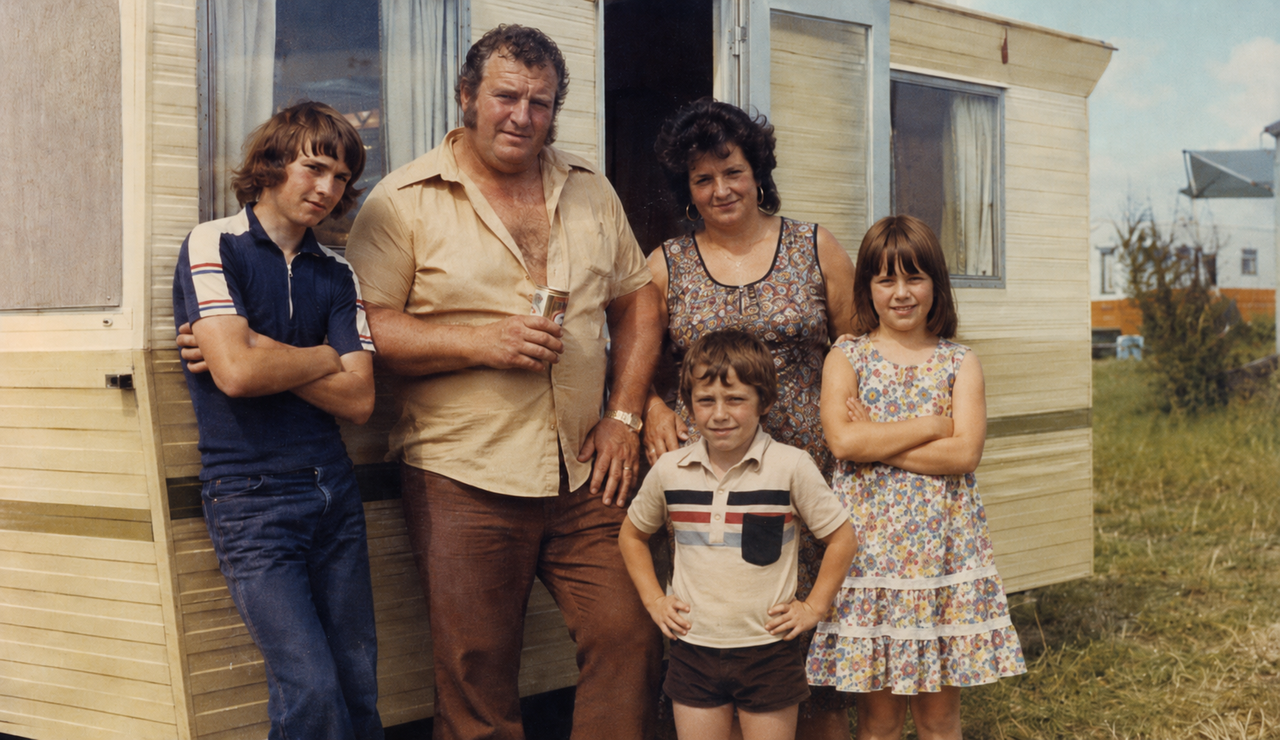
On the shelf above the television stood an old photograph from a caravan holiday. The colours had faded badly. Terry stood in the middle, broad and sunburnt, with one hand holding a beer, the other close to Tony’s right shoulder. Laura stood beside their mother. Tony’s brother was there too, slightly apart from the others, already looking as if he knew how to leave. Tony rarely looked at it, but he had never thrown it away.
Tony was a big man still, though not quite in the way he had once been. His shoulders remained broad, his hands still carried the roughness of building sites, and there was something in his face that suggested he had spent most of his life refusing to move first. But since the fall, his body had become less obedient. He walked carefully now, though he hated the word carefully. Carefully was for old women carrying tea. Carefully was for people who had accepted something. Tony had not accepted much.
He had fallen from scaffolding two years earlier and broken his back and hip. Later came the hip replacement, the hospital appointments, the physio sessions, the leaflets with smiling people on the front doing exercises beside windows. He had gone for a while, then stopped. He told Laura the sessions were useless. He told the physio he could do the exercises at home. He told himself he knew his own body better than some kid with clean trainers and a clipboard.
None of that was the whole reason.
The truth was that he hated taking his top off in front of people. Hated standing there under bright lights while someone looked at the changed shape of him. Hated being told to lift, bend, stretch, and breathe. Hated the small encouraging voice people used when they thought he was trying. He had spent most of his life being strong without anyone commenting on it. Now strangers congratulated him for moving his leg a few inches.
“Good, Tony. That’s it.” He had wanted to tell them where to go. So he stopped going.
At night, when the pain moved through his hip and settled deep into his back, he sometimes thought of his father.
Terry Linton.
People had known Terry. That mattered. In some families, love was spoken about. In the Linton family, being known was closer to the point. Terry had worked hard, drank hard, smoked cigars when he could afford them and cheaper ones when he couldn’t, and had a way of speaking that made other men quieten slightly before answering. He was not soft. He was not easy. He was not the sort of man who asked how you felt unless he thought you were “taking the mick”. But he knew things. At least, that was how Tony remembered him.
Terry had a saying for most situations. Some were funny. Some were cruel. Some were probably stolen from men older than him and passed off as his own. But one had stayed with Tony more than the others.
“All we have,” Terry used to say, “is the here and now and a bag full of memories.”
Tony had heard him say it in pubs, at funerals, after arguments, after wins, after losses, after one of the dogs died, after Tony’s mother passed from lung cancer and Terry stood in the kitchen making tea as though the kettle could hold the house together.
All we have is the here and now and a bag full of memories.
Tony did not think of it as emotional. He would have hated that. It was not poetry. It was not therapy. It was not one of Laura’s little sayings from whatever book she had beside her bed that month. It was his father’s. That made it solid. And lately, in the early hours of the morning, when the television had gone quiet and the flat smelt faintly of damp clothes, old lager and yesterday’s food, Tony found the sentence coming back to him more often.
The here and now.
A bag full of memories.
He did not know why it kept coming back. Only that it did.
The Linton Way
To grow up a Linton was to understand that a name could enter a room before you did. Especially if that name belonged to Terry Linton. He was respected, though not in any polished or polite sort of way. Men listened when he spoke. They laughed with him, argued with him, drank with him, and knew there was a point beyond which things were better left alone. Terry was not a man people were frightened of exactly, but he was not a man many chose to test either. There were families whose names carried weight before anyone from them had even walked into the room, and the Lintons had always been one of those.
They were builders, drinkers, gamblers, arguers, grafters. Men who could fix a roof, start a row, lend you a ladder, disappear to the club for six hours, and somehow still expect to be spoken of with respect. Tony understood that. His father had understood it better.
Terry Linton had thick hands, a heavy walk, and a face that rarely gave away more than it needed to. He smoked cigars on birthdays, race days, Christmas mornings, and sometimes for no reason at all except that he fancied one. Tony’s mother often rolled her eyes at him, but even that seemed to confirm his place in things. Terry belonged to a world where a man worked, earned, drank, laughed when things were funny, swore when things went wrong, and kept the rest to himself.
Tony had grown up watching him. He watched how his father held court in pubs and clubs. He watched how other men greeted him. He watched how his mother moved around him in the kitchen, sometimes fondly, sometimes angrily, sometimes as though she had long ago accepted that Terry would never become the sort of husband who asked what kind of day she had endured. Tony did not think of this as sad at the time. It was just how things were. Some men were home early. Some men were not. Some men talked. Some men provided. Terry had provided. To Tony, that had seemed like enough.
Later, when Tony became a father himself, he carried more of Terry with him than he knew. He worked long days. He came home tired. He went to the club. He liked a drink. He liked the horses. He liked being with men who did not ask questions unless they already knew the answer would be a joke. He was not a violent husband. Not in the way some men were. He did not come home swinging fists at his wife or frightening the girls from their beds. He did not have another woman tucked away somewhere. He would have been insulted by the suggestion. But absence has its own weight.
A chair can be empty so often that, eventually, nobody expects a man to sit in it. Tony would not have understood it that way.
If asked, he would have said he worked. He paid bills. He kept a roof over their heads. He never let the kids go without shoes or coats or food on the table. That mattered to him. In his mind, that was fathering. Not all of it perhaps, but enough of it. The rest was his wife’s business. Birthdays, feelings, school problems, rows between sisters, tears at bedtime, children wanting to be noticed for reasons he could not always see. His wife dealt with those things. She was better at it, he would have said. Whether she was better at it or simply left alone with it was not a question Tony had spent much time asking.
By the time the girls were older, they had learned not to expect too much from him. They knew the smell of beer on his coat. They knew the sound of his key late at night. They knew his irritation if they interrupted the racing, or asked for something at the wrong time, or wanted him to be interested in a world that had nothing to do with work, football, the club, or what he called real life.
He was not always unkind. That was part of the difficulty. There were days when he made them laugh. Days when he slipped money into their hands and told them not to tell their mother. Days when he fixed things without being asked, lifted heavy boxes, drove them somewhere in silence, stood outside in the rain waiting because one of them had missed a bus. He could be useful. He could be dependable in practical ways. He could turn up when there was a job to do. But he rarely knew how to stay when there was nothing to fix. That was the part his daughters remembered differently from him.
The Fall
The fall had changed more than Tony’s body. At first, he spoke about it as though it were simply a building-site accident. One loose board. One bad step. A shout from somewhere above him. Then the awful drop, the sound of metal, the sudden absence of ground. Men who had worked with him for years later said he had been lucky. Tony hated that. Lucky was walking away with a bruise and a story to tell at the bar. Lucky was not lying in hospital with a broken back, a smashed hip, and nurses asking if he needed help getting to the toilet.
He remembered very little of the first few days clearly. Pain made things strange. Morphine made them stranger. Faces came and went. Doctors explained things. Someone mentioned surgery. Someone else mentioned rehabilitation. Tony nodded as though he understood, because nodding was easier than asking questions. Asking questions made a man sound frightened.
Laura came most days. She brought him clean clothes, even though he couldn’t change, complained about the parking, moved things around on the little hospital table, and told him he looked better than he did. Tony told her not to fuss. She told him to shut up. That was how they were with each other. It was the closest either of them usually came to tenderness.
His daughters came once.
They stood near the bed with their coats still on, both of them older than he remembered them somehow, though of course that made no sense. One had brought her little girl with her. Tony could not remember which child it was now. Not properly. There were three grandchildren altogether, though if asked their ages he had to think longer than a grandfather probably should.
The little girl would not come near the bed. She stood half-hidden behind her mother’s leg, staring at him with wide eyes. Tony tried to make a joke of it. “What’s wrong with her? I’m not going to bite.” Nobody laughed much. His daughter put a hand on the child’s shoulder and said something soft that Tony could not hear. The girl stayed where she was. Tony looked away first. He told himself it was because he was tired. Because the pain was bad. Because hospitals frightened kids. All of that was true enough. Afterwards, when Laura asked how the visit had gone, Tony said, “Fine.”
It had not gone fine. Tony did not have another word ready.
When he came out of hospital, the world he returned to felt smaller. The stairs were harder. The flat was harder. The walk to the shop was harder. Even the club, when he eventually managed to get there, felt different. Men still nodded at him. Someone bought him a pint. Someone asked about compensation. Someone else told him about a cousin who had done his back in and never been right since. Tony listened, drank, and pretended not to notice when people glanced at the stick beside his chair.
He did not stay as long as he used to. That annoyed him more than he admitted.
The GP started with tablets. Painkillers. Something for sleep. Advice about movement. Physio. Then more physio. Then, after one appointment in which Tony had gone in complaining about his back and somehow found himself talking about not sleeping, not working, and not seeing much point in the day until it was late enough to drink, the GP mentioned counselling. Tony laughed. Not because it was funny. Because laughing was better than letting the GP see what he actually thought.
“Counselling?” he said. “What, sitting around talking about my feelings?”
The GP did not smile in the way Tony expected. She simply said that pain and sleep were often tied up with other things, and that sometimes talking helped people manage what their bodies were carrying. Tony said he would think about it.
He had no intention of thinking about it.
Laura found out anyway. Laura always found out things. She rang him that evening and started before he had even said hello properly.
“You should go,” she said.
“Go where?” Tony replied.
“You know where.”
Tony shifted in the chair, wincing as pain moved through his hip.
“I’m not doing therapy.”
“You’re not doing much else either.”
He nearly hung up then. He wanted to. Instead he stared at the television, where two men in suits were laughing at something he had missed. “You sound like Dad,” Laura said eventually. That made him look away from the screen.
“No I don’t.”
“Yes, you do,” she said. “Only worse, because at least Dad had Mum keeping the house going and work getting him out the door.”
Tony said nothing.
Laura did not soften it.
“You can sit in that flat and rot if you want. Or you can go and talk to someone for an hour and call it a load of rubbish afterwards. I don’t care what you call it. Just go.” Tony told her she was dramatic. He told her she had always liked interfering. He told her therapy was for people who had too much time and not enough backbone.
But later that night, something happened. He got up too quickly from the chair and his hip gave way. Not completely, but enough. His hand missed the armrest. His knee hit the carpet. The pain came sharp and hot, and for a few seconds he could not move. The television carried on talking above him. His phone sat on the table, just out of reach. He lay there, breathing hard, angry before he was frightened. Then frightened anyway.
No one came.
Of course no one came. He had not called anyone. No one knew. Still, for one stupid moment, the flat seemed to show him something he did not want to see. The cans on the table. The dirty sink. The phone that rarely rang. His own body on the floor, too heavy and too proud to ask for help. When he finally managed to pull himself up, he sat for a long time without turning the television off.
The next morning, he rang the number the GP had given him. When Laura asked about it later, he said, “I’ve booked the stupid thing. Happy now?”
Laura said yes.
Tony said, “It’s not therapy. It’s just some bloke they’ve told me to speak to.”
“Call it what you like,” Laura said. “Just go.”
The First Session
Tony nearly cancelled the first session twice. The first time was the night before, when his hip was bad and the thought of sitting in a room with some stranger asking questions made him feel irritated before anything had even happened. The second was the morning itself, when he stood by the front door with his coat on, staring at the appointment card on the table as though it had personally offended him. He went anyway, not because he believed in it, and not because he had changed his mind, but because Laura would ask, the GP would probably mention it again, and he had already told them he would. There were still some things Tony did not like backing out of once he had said them aloud.
He arrived ten minutes early and waited outside in the cold rather than go in. He stood near the entrance with his hands in his pockets, watching people pass on the pavement, looking up and down the street more than once to check nobody he knew was about. Nobody was, but that did not stop him checking again. When he finally stepped inside, he told himself he would give it one session. One session, then he could say he had tried it.
The room was smaller than he expected. Two chairs. A small table. A box of tissues placed where people could see them. Tony noticed that straight away and nearly laughed. He hated the tissues. Hated what they suggested. Hated that someone had thought they might be needed. The therapist greeted him and invited him to sit wherever he liked, so Tony chose the chair nearest the door, lowered himself into it carefully, annoyed by the effort it took, then stretched one leg slightly in front of him as though making space rather than protecting his hip.
There was a brief silence. Tony looked at the carpet. “So,” he said, before the therapist could speak, “what do you want to know?” The therapist did not rush to answer, which annoyed him too. Eventually, the therapist said they could begin wherever Tony wanted. Tony gave a short laugh. “Well, that’s helpful.” The therapist did not seem offended. That made things worse in a way. Tony had expected something. A correction perhaps. A professional smile. A bit of nonsense about safe spaces or opening up. Instead, the therapist simply remained where he was, not pushing, not retreating, not filling the room because Tony had made it uncomfortable.
Tony shifted in the chair. “My GP reckons this might help with sleep,” he said. “My sister reckons I’m turning into my old man. So here I am.” He said it as though that explained everything. The therapist asked what Tony thought. Tony looked at him then. “What do I think? I think people have too much time on their hands these days.” The therapist nodded slightly, as though this was an answer worth taking seriously. Tony continued. “Years ago, you got on with things. You had a problem, you dealt with it. You didn’t sit around talking about every little thing that went wrong.” The therapist waited a moment before asking, “And has getting on with things been working?” Tony’s jaw tightened. He did not like that, not because it was rude, because it wasn’t. That was the trouble. If the therapist had been rude, Tony could have dismissed him. But the question sat there calmly, without accusation, and Tony could feel himself wanting to knock it away. “I’m here, aren’t I?” he said.
For a while they spoke about sleep. Tony described it practically. What time he went to bed. How often he woke. Where the pain sat. Which tablets worked and which did nothing. He could talk about the body if the body stayed mechanical. Hip. Back. Medication. Mattress. Walking. Stairs. Things that could be named without sounding weak. When the therapist asked about the fall, Tony gave the short version. “Scaffolding. Bad board. Went down. Broke a few bits. That’s it.” The therapist asked, “That’s it?” Tony looked towards the window. “What else is there?” The therapist did not answer for him.
That silence was different from other silences. Tony knew silence in pubs, the kind before someone said the wrong thing. He knew silence at home, the kind his wife had used near the end when she had stopped expecting him to ask what was wrong. He knew the silence on the phone when one of his daughters answered and clearly wished she had not. This silence was not like those. It did not threaten him. It did not let him off either.
Tony shifted again and reached into his coat pocket, forgetting for a moment that he was not allowed to smoke indoors. His fingers found nothing useful there. Just keys, a receipt, and the cracked edge of his phone. “My sister thinks I should talk about my Dad,” he said eventually. The therapist asked what made Laura think that. Tony shrugged. “Because she’s Laura.” He expected the therapist to smile, but he did not. Tony sighed. “He died a few years back. Eight now, maybe. Give or take.” He said it casually, as though discussing someone who had moved away.
The therapist asked what his father had been like. Tony gave another short laugh, but it had less force this time. “Terry Linton? You’d have known if you’d met him.” For the first time since arriving, Tony seemed almost interested in what he was saying. “He was old school. Proper old school. Worked hard. Drank hard. Didn’t take rubbish from anyone. Everyone knew him.” The therapist listened, and Tony went on a little longer than he meant to. Not about missing him. Not about grief. Nothing like that. He spoke about Terry’s sayings, his cigars, and the club, how men would move down the bar to make room for him. He spoke about the time Terry had argued with a landlord for watering down the spirits, and the time he had fixed a neighbour’s roof in the rain because “a job’s a job.” He spoke with irritation and admiration tangled together, though he would have called it neither.
Then, without quite planning to, Tony said the sentence.
“All we have is the here and now and a bag full of memories.”
The therapist waited. Tony looked down at his hands. “That’s what he used to say.” There was another silence, and Tony did not like this one as much. The sentence seemed to hang in the room after he had said it, sounding different there than it did in his flat or in his head at three in the morning. In the room, it sounded less like something solid and more like something that might be opened. Tony cleared his throat. “Anyway,” he said. “That was him.”
The therapist asked what the saying meant to Tony. He almost stood up then. Not actually, but something in him moved that way. “What does it mean?” he repeated. “It means what it says.” The therapist nodded. Tony looked at the tissues again and hated them even more now.
By the end of the session, Tony had not cried, had not discovered anything, and had not thanked the therapist in any meaningful way. When asked whether he wanted to book another appointment, he said he would “see how it goes,” which in most situations meant no. But he booked one anyway. Outside, he stood on the pavement and checked his phone. No missed calls. One message from Laura.
“Well?”
Tony typed back with one thumb.
“Waste of time.” Then, after a moment, he added:
“Going again next week.”
The Bag
Tony went back the following week, then the week after that, though he never described it that way to anyone. If Laura asked, he said he had “another appointment.” If the GP asked, he said he was “doing the thing.” If one of the men at the club asked where he had been on Tuesday afternoons, Tony said physio, even though he had not been to physio in months. That answer was useful because nobody asked much after that. Men understood backs, hips, knees, shoulders, aches, pains, operations and waiting lists. They understood a body going wrong, and the need not to say too much about what that meant. They did not always know what to do with a mind that had started keeping a man awake.
In the sessions, Tony mostly talked around things. He talked about the flat being damp, the council being useless, the price of a decent pint, the state of building work now compared to when he had started. He talked about young lads on sites who did not know how to hold a broom properly, let alone do a day’s graft. He talked about the horses, sometimes with a little more energy than he showed anywhere else, and about the club, where the same men told the same stories and laughed in the same places. The therapist listened to all of it. Tony noticed that too. He noticed the lack of hurry, the lack of correction, the way the therapist did not try to drag him back every time he wandered somewhere safer.
That did not mean Tony trusted him. Trust was too soft a word, and too generous. But he began to understand that the therapist was not easily frightened off. He could be sarcastic, evasive, dismissive, quiet, difficult. He could say, “I don’t know,” even when he probably did. He could complain that talking was pointless and still find himself talking for most of the hour. The therapist did not seem impressed by his hardness, but neither did he seem offended by it. That was harder to deal with than Tony had expected.
The sentence about the bag returned before either of them had planned it. It came after Tony had been talking about his father again, though he would have denied that he talked about him often. Terry appeared in stories as though by accident. Terry at the bar. Terry on site. Terry arguing with someone. Terry refusing to go to the doctor. Terry telling Tony, aged fourteen, that if he wanted money in his pocket he had better learn what work was. Terry after Tony’s mother died, making tea in the kitchen and saying very little. Tony told these stories as if they were about Terry, but the room had a way of making them sound as though they were also about Tony.
“He had sayings for everything,” Tony said one afternoon, leaning back in the chair with his bad leg stretched out in front of him. “You didn’t always like them, but you listened.” The therapist waited. “That was Dad,” Tony said. “He’d say something and that was it. You might not agree, but you’d remember it.” There was a pause. Tony rubbed his thumb along the cracked edge of his phone. “All we have is the here and now and a bag full of memories,” he said again.
This time the therapist did not simply let the sentence pass. “And what kind of memories are in the bag?” he asked. Tony looked at him as though the question itself had taken a liberty. “What kind of question is that?” The therapist said it might have been a question the saying left behind. Tony shook his head. “No. Dad wouldn’t have asked it like that.” The therapist accepted this. He did not argue with Terry, which helped. Tony did not take many things well, but he took any hint of someone making his father sound foolish even worse.
“What would he have said?” the therapist asked after a while. Tony looked towards the window. Outside, someone walked past carrying shopping bags, head down against the weather. For a moment Tony seemed to be somewhere else, not in the room exactly, but not fully outside it either. “He’d say it doesn’t matter what’s in it,” Tony said. “You carry it anyway.” The words surprised him a little. Not enough to show, but enough to make him shift in the chair.
The therapist repeated them quietly. “You carry it anyway.” Tony did not answer. He had not meant to say anything that sounded like that. It made him feel as though he had accidentally taken his shirt off again, though this time there were no bright lights and no young physio telling him he was doing well. He stared at the floor and waited for the therapist to make too much of it. The therapist did not. That helped.
Over the next few sessions, the bag became something they returned to, though never in a way Tony would have called important. Sometimes the therapist asked what Tony was carrying. Sometimes Tony said, “Bills, mainly,” or “bad luck,” or “a dodgy hip and two daughters who can’t stand me.” He said these things with a half-smile, daring the therapist to make them serious. Sometimes the therapist did. Not heavily. Not with pity. Just enough to stop the joke from closing everything down.
It was during one of those sessions that Tony mentioned his daughters by name for the first time. Until then they had mostly been “the girls,” as though they were still young enough to be called that, though both had families of their own now. Saying their names seemed to irritate him. It made them too separate from him, too adult, too capable of having their own version of events. He said one had two children and the other had one. He got the ages wrong, corrected himself, then became annoyed, as though the numbers had changed deliberately to embarrass him.
“They don’t ring,” he said. The therapist asked whether he rang them. Tony’s face closed. “They’ve got my number.” It was the kind of sentence that could hold a whole life if nobody touched it too quickly. The therapist let it sit for a while before saying, “So the phone works both ways.” Tony looked at him sharply. “You taking their side now?” The therapist said he was not taking sides. He was wondering whether waiting had become easier than risking the call. Tony hated that. Not because it was wrong. Because it made the cracked phone in his pocket feel suddenly heavier.
He did not call them that week. He did not call them the next week either. But he thought about it more than once, usually late at night, when the television had gone quiet and the flat had settled into its usual smell of damp, old food and beer. He would pick up the phone, press the screen in the right place to make it light up, then put it down again. There was always a reason. Too late. Too awkward. Nothing to say. They would not answer anyway. Their mother would have filled their heads. They were busy. He was tired. All of these things were true enough. True enough was often better than true.
Then, one Tuesday afternoon, the therapist asked him whether the bag was only for memories already made. Tony frowned. “What?” The therapist referred back to his father’s saying: the here and now and a bag full of memories. He wondered aloud whether the bag was closed. Tony stared at him. “That sounds like one of your lines.” The therapist accepted that it might. “My dad wouldn’t have said that,” Tony said. “No,” the therapist replied. “Maybe not.”
Tony looked down at his hands. They were still large hands. Scarred, rough, marked by work that had outlasted the work itself. For most of his life, those hands had known what to do. Carry, lift, grip, fix, push, and hold. Now they often rested uselessly in his lap while other people asked him questions he could not answer. “The bag’s still open,” he said eventually, almost under his breath. The therapist did not move. Tony seemed annoyed by his own words and added quickly, “Until it’s not, I mean.”
There it was. Not a breakthrough. Not a revelation. Nothing anyone would have put in a film. Just a sentence spoken in a small room by a man who still did not want to be seen speaking it. The therapist said nothing for a moment, and Tony preferred that. If the therapist had smiled, or praised him, or repeated the words too warmly, Tony might have taken them back. Instead, the sentence remained between them, not claimed by either of them completely. Some part of it belonged to Terry. Some part to Tony. Some part, though Tony would never have admitted this, to the strange and irritating fact that another person had sat with him long enough for the old saying to change.
When Tony left that day, he told the therapist he still thought most of this was nonsense. The therapist did not try to persuade him otherwise. Tony gave a short laugh at that, though not unkindly. Outside, he stood by the road with his coat collar up against the wind. For a moment he thought about going straight to the club, but instead he took out his phone. The screen flickered, went dark, and then came back when he hit it against his palm. He opened his daughter’s name and stared at it until the letters began to look almost unfamiliar.
He did not call.
But he did not put the phone away either.
Something New in the Bag
After that session, Tony did not become a different man. He still went to the club. He still drank more than his GP would have liked. He still complained about the flat, the council, his hip, the price of everything, and young people who did not know they were born. He still avoided physio, though now he avoided it with slightly less confidence. He still told Laura that therapy was mostly rubbish, and Laura, who knew him well enough not to push too hard when something was beginning to move, usually told him that was no reason to stop. But the sentence stayed with him.
The bag’s still open.
He did not repeat it to anyone. Not at the club. Not to Laura. Certainly not to his daughters. But it began to irritate him in the way certain thoughts can irritate a person when they arrive too often and refuse to become useful. He would be watching television and find himself thinking about it. He would wake at three in the morning with his hip aching and hear it somewhere behind his father’s old saying, like a second voice added badly to a song he had known all his life. He resented it at first. It sounded too much like therapy. Too much like the sort of thing someone would put on a poster beside a picture of a sunset. But it had come from him, which made it harder to dismiss.
One night, after two cans and half a programme he had stopped following, Tony picked up his phone and opened his eldest daughter’s name. He stared at the thread for a while. The last message was months old and practical. Something about a hospital appointment, perhaps, or a birthday he had remembered too late. There was no warmth in it, but there was no shouting either, which Tony told himself was something. His thumb hovered over the cracked screen. He thought about writing, “You all right?” Then deleted it before sending. It sounded too soft. He tried, “How’s things?” That sounded worse. He put the phone down, swore under his breath, picked it up again, and finally typed, “Hope you and the kids are okay.”
He stared at the message for so long that the screen went dark. When it came back on, he pressed send before he could change his mind. For several minutes nothing happened. Tony placed the phone on the table beside the empty cans and tried to watch television. Then he picked it up again. No reply. He told himself he had not expected one. He told himself she was probably busy. He told himself she had always been like her mother when she wanted to make a point. None of these thoughts helped. The message sat there, small and humiliating, proof that he had reached and not been met. By midnight, he wished he had not sent it. By morning, he had decided he did not care.
She replied just after lunch. “We’re fine. Kids are good.” That was all.
Tony looked at the message for a long time. It was not much. It was almost nothing. A person could read it as polite, cold, cautious, busy, annoyed, or merely ordinary. Tony read it all those ways and then none of them. He wanted to answer quickly, but did not know how. He wanted to leave it, but leaving it felt like losing something he could not name. In the end, he wrote, “Good”, and sent it before he could make it worse.
In therapy that week, he mentioned it as though it were nothing. He spoke first about the weather, then about a horse that had lost him money, then about a man at the club who had been barred for arguing with the steward. Only near the end, as if remembering something unimportant, he said, “I texted one of the girls.” The therapist asked how that had been. Tony shrugged. “Fine.” There it was again. Fine. The word he used for hospital visits, family rows, sleepless nights, phone calls that had not gone well, and almost anything else that might require a better answer. The therapist did not challenge it straight away. He waited long enough for Tony to hear the thinness of it.
“She replied,” Tony added.
“That mattered?”
Tony looked irritated. “I didn’t say that.”
“No.”
“I only said she replied.”
The therapist nodded. “And I wondered whether that mattered.”
Tony looked away. For a moment he seemed ready to dismiss the whole thing, to talk about the club or the weather or the uselessness of texting. But something in him appeared too tired to keep pushing everything aside. “Better than nothing, I suppose,” he said.
It was not a tender sentence. It was not an apology. It did not repair years of absence, missed school events, late nights, and his wife carrying the emotional weight of a household while Tony called work and bills enough. But it was something. In Tony’s world, something was not small. Something was often the most a person could manage without feeling foolish.
The therapist did not praise him. That helped. Praise would have ruined it. Praise would have made it sound as though Tony had done something brave, and Tony would have had to deny that immediately. Instead, the therapist asked whether he had thought about texting the other daughter. Tony gave him a look. “Don’t push your luck,” he said. The therapist accepted this, though the question had already done what questions sometimes do. It had placed another possibility in the room.
A few days later, Laura rang. Tony nearly did not answer, because he suspected his daughter had told her about the message and he did not want a performance. But Laura did not mention it straight away. She asked about his hip, then about whether he had eaten properly, then about whether he had gone back to physio. Tony said no to the last one with more irritation than the question deserved.
“You should,” Laura said.
“Here we go.”
“I’m serious.”
“You usually are.”
“You gave up because you didn’t like being looked at.”
Tony’s grip tightened around the phone. “You don’t know what you’re talking about.”
“Yes, I do,” Laura said. “You’ve always hated anyone seeing you struggle.”
Tony nearly hung up again. Laura had a talent for putting her hand exactly where the bruise was and then acting surprised when he flinched. He told her she should have been a detective. She told him he should have been less of a stubborn sod. They argued for a few minutes in the old way, the safe way, the way that allowed affection to disguise itself as irritation. But the following Monday, Tony rang the physio department. He did not tell Laura.
He did not tell the therapist either, not at first. He went once and came home furious. The room was too bright. The exercises were too easy and somehow still too difficult. The physio was polite, which annoyed him. A man half his size asked him to stand, sit, lift, hold, and breathe. Tony hated the mirror on the wall. Hated the way his shirt pulled across his stomach. Hated the sweat on his back. Hated needing help to do badly what he once would have mocked another man for struggling with.
But he went back the next week.
That was how change arrived for Tony. Not as insight. Not as confession. Not as some clean emotional breakthrough. It came disguised as irritation, as something done grudgingly, as a text sent badly, as an appointment attended without being announced. It came in movements so small that he could almost pretend they had not happened. Almost.
In therapy, when he eventually admitted he had gone back to physio, he did it with contempt. “Waste of time mostly,” he said. The therapist asked why he had gone twice. Tony stared at him for a second, then gave a short laugh.
“Because I’m an idiot.”
The therapist smiled slightly. “Perhaps.”
Tony shook his head, but he was smiling too, though not enough to make anything of it. For the first time, the room did not feel quite as much like a place he had been sent. It still annoyed him. The tissues still sat there like an accusation. The questions still came too quietly and landed too deeply. But somewhere along the way, without permission and without Tony agreeing to it, the room had become part of the week. Tuesday afternoons. The chair near the door. The therapist who did not clap when he did something difficult. The old saying that had started to misbehave.
The bag was still open.
Tony would not have put it like that. Not yet. Maybe not ever. But something had begun to enter it all the same.
Until It’s Not
Tony kept going for a while after that, though he never became comfortable with it. Comfortable was too strong a word. He still sat near the door. He still told the therapist that most of what they spoke about was “common sense dressed up,” and he still left some sessions wondering why he had bothered. But he kept turning up. Tuesday afternoons became something he complained about and protected in almost equal measure, though he would not have described it like that to anyone, least of all himself.
Outside the room, life did not suddenly become easier. His hip still hurt. The flat still needed cleaning. The club still offered him the familiar comfort of men who asked little and remembered less. His daughters remained cautious, and Tony remained Tony. But there were small differences now, the sort a man could almost deny if nobody looked too closely. He answered Laura more often. He kept some of the physio cards in a drawer. He had sent one or two messages to his daughter and received one or two back. Nothing had been repaired exactly, but not everything was where it had been.
There were other small things too. He bought fewer cans some weeks, then more the next, as though change itself annoyed him and needed punishing. Once, after a session in which the therapist had asked whether being useful had sometimes been easier than being close, Tony went home and fixed the loose handle on the kitchen cupboard. It had been loose for months. No one saw him do it. No one thanked him. But afterwards he stood in the kitchen for a moment, opening and closing the cupboard door, listening to the clean click it made when it shut.
Near the end, Tony began talking about stopping. Not dramatically. He did not storm out or announce that therapy was useless. He simply started saying things like, “Can’t keep doing this forever,” and “I reckon I’ve said what I’ve got to say,” and “You must be sick of hearing about my old man by now.” The therapist did not argue with him. That annoyed Tony too, though less than being argued with would have done. Part of him wanted the therapist to say he should stay. Another part wanted to be left alone. Most of him did not want to know which part was bigger.
In what became their final session, though neither of them called it that at first, Tony spoke about Terry again. He spoke about the club, the cigars, the way men had made room for him at the bar, and the way his mother had rolled her eyes and carried on with whatever needed doing. He spoke without the usual force, as though the stories had been handled often enough now to lose some of their sharpness. Then he spoke about his daughters. Not much. Just enough to say one had answered his message and the other probably still would not. He said this with a hard little smile, but it did not hold for long.
“She’s got every right, I suppose,” he said. The therapist waited. Tony looked towards the door. “I wasn’t around much.”
It was not an apology. Not yet. Maybe not ever. But it was the nearest thing to one that had entered the room in Tony’s own words. He seemed to know it too, because he shifted almost immediately, clearing his throat and reaching for the safer ground of irritation. “Doesn’t mean I was some monster,” he added. “No,” the therapist said. “It doesn’t.”
Tony looked at him then, as if checking whether the answer could be trusted. He found no pity there, which helped. Pity would have made him angry. Blame would have made him leave. This was neither. It was simply a place where more than one thing could be true. He had worked. He had provided. He had not been violent. He had not betrayed his wife with another woman. He had also been absent. He had left too much to other people and then felt wronged when those people learned how to live without him.
For a while, neither of them said much. Eventually, the therapist asked what Tony thought he would take from the work. Tony gave the sort of look he usually reserved for people who said something ridiculous on television. “Take from it?” he said. “You make it sound like I’ve been on a course.” The therapist smiled slightly. Tony looked away, but he was not as annoyed as he might once have been. “I don’t know,” he said. “Still think most of it’s nonsense.” The therapist let that stand.
Tony rubbed his hand across his face. He looked tired. Older than he liked to look, but less armoured somehow, as though some part of him had stopped holding itself quite so tightly. Tony looked down at his hands. “That thing Dad used to say,” he said. “Here and now. Bag full of memories.” He paused. “Still right, that.” The therapist did not answer too quickly. Tony nodded once, more to himself than to the therapist. “But the bag’s still open, isn’t it?” He looked away, embarrassed almost as soon as he had said it.
“Until it’s not.”
He seemed embarrassed after saying it and made a joke about being charged extra for coming out with lines like that. The therapist let him have the joke. It was kinder that way. When the session ended, Tony stood slowly, buttoned his coat, and said he might book again after Christmas, depending on how things were. Both men understood that he might not. At the door, Tony turned as though he had forgotten something, then appeared to think better of it. “Anyway,” he said. “Thanks.” It was not much. For Tony, it was quite a lot.
Outside, the afternoon had already begun to darken. Tony stood on the pavement and checked the street before taking out his phone. No one he knew was nearby. The screen flickered when he pressed it, then came on after he hit it against his palm. There was a message from Laura asking how it had gone. Tony typed, “Done now”, then deleted it. He typed, “Alright”, then deleted that too. After a moment he put the phone back in his pocket and started towards the bus stop, walking carefully, though he still hated that this was what walking had become.
Halfway there, he stopped. He took the phone out again and opened his daughter’s name. For a long time he did not type anything. Cars passed. People moved around him. Somewhere behind him, a pub door opened and a burst of laughter came briefly into the street before being swallowed by traffic. Tony stood with the cracked phone in one hand and his other hand resting against his bad hip, looking at the empty message box.
Then he began to write.
The bag was still open.
Generativity, Stagnation and the Difficulty of Being Reached
Tony’s story can be thought about through Erik Erikson’s idea of generativity and stagnation. Erikson suggested that in middle adulthood, a person often faces a particular emotional task: whether they can continue to give something of themselves to life, to others, and to the generations that follow, or whether they become increasingly closed around what has already happened. Generativity is not simply having children, nor is stagnation simply being alone. A person may have children and grandchildren and still struggle to feel connected to what continues after them. Equally, a person may have little family around them and still live generatively through care, work, mentoring, creativity, friendship, or repair.
For Tony, this conflict was not just an idea. His daughters existed. His grandchildren existed. But they existed at a distance he did not know how to cross. He had, in one sense, built a family. He had worked, paid bills, fixed things, carried heavy objects, stood in the rain, driven people where they needed to go, and done many of the visible tasks he associated with being a man. Yet the emotional life of the family had largely gone on without him. Birthdays, school worries, tears, fears, rows, disappointments, small triumphs, and the delicate work of being known had mostly belonged elsewhere. When the marriage ended and the daughters moved further away from him, Tony was left with the painful fact that provision had not created the closeness he thought it should have earned.
This is where stagnation can become more than a lack of activity. Tony was not lazy. He was not a man who had avoided work. In fact, work had been one of the main ways he had known who he was. But after the fall, the old routes into usefulness were damaged. His body no longer obeyed him in the same way. His place on building sites was gone. His authority in the family had weakened. His father was dead. His marriage was over. His daughters did not call. The club remained, but even there he stayed less long than before. Life had not stopped altogether, but it had narrowed. The days became organised around pain, sleep, drink, appointments, resentment, and memory.
In this sense, Terry Linton’s saying carried both comfort and danger. “All we have is the here and now and a bag full of memories” was not a soft phrase. It did not invite confession. It did not ask Tony to cry. It belonged to his father’s world: practical, blunt, unsentimental, and somehow strong enough to be repeated. At first, the saying helped Tony hold on to Terry. It allowed him to keep his father’s voice alive without needing to speak of grief directly. But over time, the same phrase also risked becoming closed. A bag full of memories can become a place where life is stored after it has already happened. The danger for Tony was that the bag had begun to feel already packed.
The therapeutic movement came not through Tony abandoning the phrase, but through the phrase changing. This matters. Therapy did not replace Terry’s words with more polished psychological language. It worked with what Tony brought. The father’s saying was not dismissed as defensive or old-fashioned. It was treated as something alive enough to be turned over, questioned, and added to. When the words shifted into “the bag’s still open, until it’s not,” something small but important happened. The past was not erased. Terry was not betrayed. But the sentence no longer belonged only to memory. It began to point towards time still remaining.
This is where Erikson’s idea of generativity becomes useful. For Tony, generativity would not look like a dramatic transformation. It would not mean becoming emotionally fluent, apologising beautifully to his daughters, or suddenly becoming a playful grandfather who knew what to do with children on the carpet. That would not be Tony. His movement towards generativity would be rougher and smaller: sending one awkward text, going back to physio without telling anyone, allowing a therapist’s question to remain in his mind, wondering whether one more memory could still be made before the bag finally closed. These are modest acts, but for a man like Tony they are not small. They require him to move against the habits that have protected and imprisoned him for most of his life.
Michael Balint’s idea of the basic fault also helps us understand why Tony could not be reached directly. For Balint, some emotional difficulties are not experienced as ordinary conflicts that can be explained or interpreted. They feel more like a crack in the foundations of trust itself: something missing, unreliable, or unsafe at the level of relationship.
Some clients do not arrive in therapy ready to speak symbolically about grief, longing, shame or regret. To approach them too quickly with emotional language may only strengthen the very walls that brought them there. Tony’s sarcasm, contempt, evasiveness and suspicion were not simply obstacles to the work. They were part of the work. He had learned to meet vulnerability with ridicule, dependence with irritation, and shame with hardness. The therapist could not break this down by force, nor would praising Tony too warmly have helped. Praise would have humiliated him. Pity would have enraged him. Interpretation offered too early might have sounded like another professional telling him to lift, bend, stretch, and breathe.
Instead, the therapy had to become a place Tony could test without fully knowing he was testing it. Could the therapist tolerate his dismissiveness? Could the room survive his silence? Could his father be spoken of without being mocked, reduced, or sentimentalised? Could Tony say something that mattered and not have it seized upon too quickly? In Balint’s terms, the work had to respect the depth of the difficulty. Tony was not merely withholding a softer self that could be easily uncovered. His whole way of being had been organised around not needing too much, not showing too much, and not being seen in the wrong kind of way.
This is why the smallness of Tony’s progress matters. A text message to a daughter may look ordinary from the outside. Returning to physio may look practical. Sitting in a room for another week may look unimpressive. But inside Tony’s emotional world, these acts represented movement across territory he had spent years avoiding. They were not sentimental gestures. They were not neat repairs. They were signs that something in him, however reluctantly, had begun to turn back towards life.
The tragedy is that Tony may never fully recognise this as change. He may continue to call therapy nonsense. He may continue to hide the appointments from the men at the club. He may still joke when something hurts and become irritated when someone asks the right question too gently. But perhaps this is part of the honesty of the work. Not every client leaves therapy with insight they can name. Some leave with a sentence. Some leave with a slightly different relationship to an old memory. Some leave having moved one step towards the people they thought had already gone.
For Tony, that step was enough to matter.
Further Information
If you would like to read more about psychodynamic therapy and the way I work, please click on the links below or feel free to browse through my site.
References
Erikson, E. H. (1950). Childhood and Society. New York: W. W. Norton
Erikson, E. H. (1982). The Life Cycle Completed. New York: W. W. Norton