When Can I Go Home? (Dementia, Fathers and the Things That Cannot Be Repaired)
When Can I Go Home?
(Dementia, Fathers and the Things That Cannot Be Repaired)
The Good Boy
By the time Bill arrived, Derek had already eaten lunch.
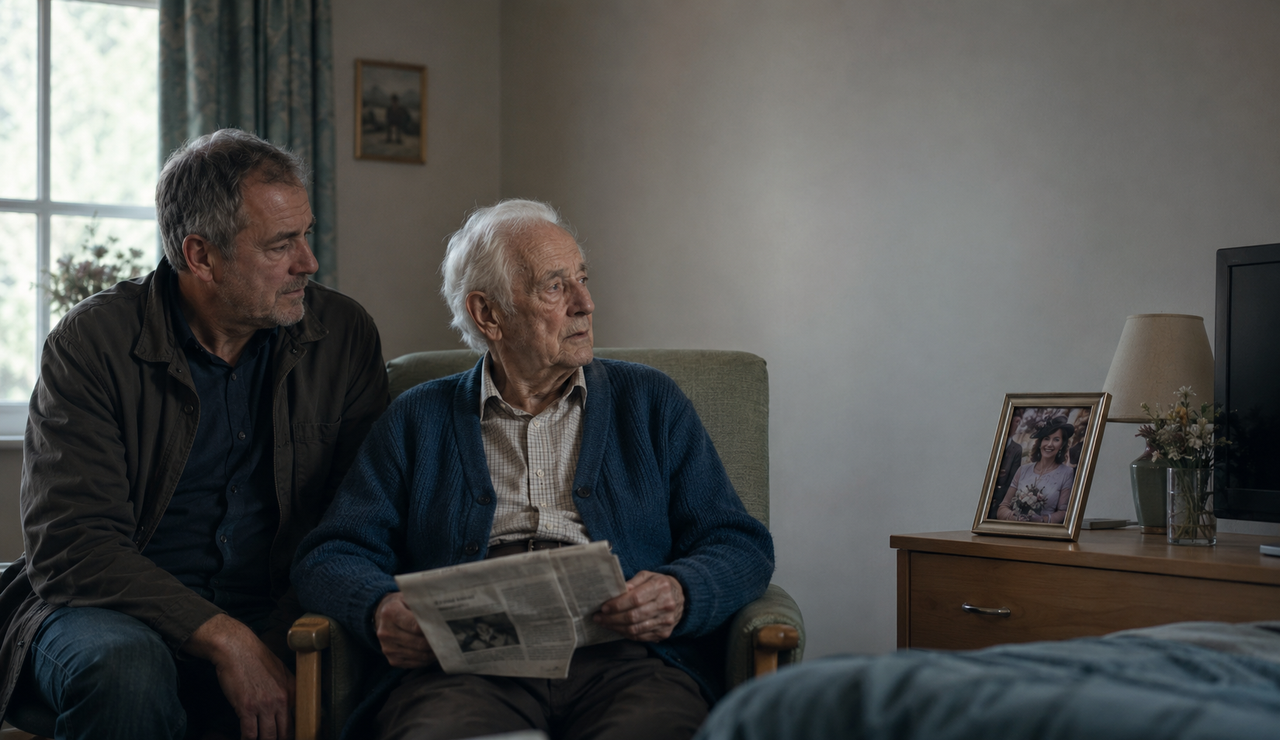
The tray had been taken away, but a small dish of rice pudding remained on the table beside him, untouched except for the skin that had formed across the top. Derek was sitting in the armchair nearest the window, wearing the blue cardigan Joan had bought him the previous Christmas. One sleeve had ridden halfway up his forearm. He had lost weight since moving into the home. Bill noticed it most around the wrists.
The television was on without sound. A daytime quiz show moved brightly across the screen while two other residents slept in chairs nearby. Somewhere farther down the corridor a woman was calling for Margaret. She had been calling for Margaret the last three times Bill had visited. Nobody seemed to know who Margaret was.
Derek looked towards him when he entered. For several seconds Bill could not tell whether he had been recognised.
Then Derek lifted one hand and said, “Alright?”
Bill answered in the same register – “Alright, Dad” – and sat beside him. He had brought the newspaper, although Derek no longer read much beyond the headlines, and a packet of chocolate digestives that would probably be put into the locked cupboard by one of the staff before the afternoon was over. He placed both on the table and asked how lunch had been. Derek looked at the rice pudding and said, “Not bad.”
It was the sort of answer he had given for most things all his life. Food was not bad. Holidays were alright. A new car did the job. Praise, when it came, tended to arrive disguised as the absence of criticism.
Bill asked whether he had been outside that morning. Derek said he had been working.
Bill did not correct him.
There had been a time when he corrected almost everything. The date. The day. The fact that Elizabeth had been dead for twenty years. The fact that the house in Chingford belonged to another family now. He had believed accuracy was a kind of kindness. If he could keep the facts straight enough, perhaps his father would stay somewhere near them.
He had stopped believing that.
Derek turned towards the window and said, “When can I go home?”
Bill looked at him and said, “You are home, Dad.”
“Your mum will be wondering where I am.”
“Will she?”
Derek’s “Course she will” came with mild irritation.
Bill let it pass.
Outside, a member of staff was pushing a wheelchair along the path around the small garden. The resident in it wore a knitted hat despite the warmth. Derek seemed content for a while. Then he began talking about a job he had once had in Walthamstow, something involving a manager who never knew what he was doing and a van that broke down twice in one week. Bill had heard versions of the story before, but not this precise version. He listened. Sometimes Derek remembered forty years ago better than forty minutes ago.
Halfway through, Derek stopped. His attention moved from the window to Bill’s face and remained there with an unusual directness. Bill had learned not to decide too quickly whether such looks meant confusion or recognition. Derek reached across and put a hand on his forearm. He had never been a man who touched people much, and the contact was light, almost uncertain.
“You’ve always been a good boy,” he said.
Bill felt the words before he understood them. His throat tightened as he looked down at his father’s hand, the skin across the knuckles thin and mottled, the nails cut neatly by somebody else. Derek squeezed his arm once and added, “You always have been, Liam.”
Bill did not move.
The television audience applauded soundlessly behind them.
A member of staff came into the lounge carrying a laundry basket, smiled at Bill and carried on towards the corridor. Derek had already released his arm.
Within a minute he was asking whether the van had been collected from the garage.
Bill stayed for another forty minutes.
He did not correct the name.
The First Session
He told the therapist about it three days later.
Not immediately. Bill spent the first ten minutes talking about the care home fees, the difficulty getting anyone from the local authority to return a call and a locksmithing job in Woodford that had taken twice as long as it should have because the customer had ordered the wrong lock online and still wanted to argue about the price.
The therapist listened until Bill ran out of practical matters. Eventually Bill said that Joan thought he was angry. When the therapist asked whether she was right, Bill gave a short laugh. “Apparently.”
He had been married to Joan for thirty-nine years. She was not a woman who needed a therapist to tell her when her husband was angry. She knew by the way he closed kitchen cupboards and by how long he spent cleaning tools that were already clean. She knew when he had taken a job too late in the day because he did not want to go home yet. She knew the difference between Bill being tired and Bill saying he was tired because the alternative would require a longer conversation.
It was Joan who had suggested therapy.
Not after one dramatic incident, but after months of watching his life narrow around Derek. Work. Phone calls. Visits. Forms. Medication. Arguments with Liam. Conversations about care that seemed to begin again every time they ended.
Bill had refused twice.
The third time Joan said, “I don’t think this is only about the dementia.”
That annoyed him enough to make the appointment.
He told the therapist that Derek had Alzheimer’s disease. He explained the move from the old house to sheltered housing, then from sheltered housing into residential dementia care. He described the wandering, the food left under the grill, the bathwater running through the ceiling of the flat below and the medication blister packs found unopened in a kitchen drawer. He spoke for nearly twenty minutes without saying what he felt about any of it.
Only then did he describe the care-home visit: Derek’s hand on his arm, the sentence, the wrong name.
“He called me Liam,” Bill said, then added, with an accusation in his voice that he immediately disliked, “My brother. He lives in America. He’s got his own life.”
The therapist asked what had happened when Derek used Liam’s name. Bill shrugged and said nothing had happened because his father had Alzheimer’s. The therapist agreed that this might explain the confusion, but added that it did not describe Bill’s experience of it. Bill looked at him then.
For a moment he wanted to say that it had been nothing. A mistake. A damaged brain attaching the wrong name to the right face. He understood all of that. He had read enough leaflets, sat through enough appointments and spoken to enough nurses to know that confusion was not rejection.
Instead he said, “For about two seconds, I thought he meant me.” He rubbed one thumb across the side of his index finger where a small cut had hardened from the previous week’s work. “That sounds pathetic, doesn’t it? I’m sixty-two. My dad’s eighty-five and half the time he doesn’t know where he is.”
The therapist did not rescue him from the sentence. Bill stared down at his hand.
“I still wanted it.”
Elizabeth
When Bill thought about childhood, his mother usually appeared first.
Not because Derek was absent. He was there. He worked, came home, ate dinner, watched television, fixed things and complained about people who had failed to fix them properly before him. He took the family on holiday. He paid the mortgage. He was present in photographs.
But Elizabeth gave the house its emotional weather.
She liked noise. Music in the kitchen. People coming over. Family parties that started with tea and sandwiches and somehow ended with half the adults dancing in a room that had not been designed for dancing. She could make an ordinary Saturday feel occupied.
Derek tolerated parties more than he enjoyed them. He would sit with the men, drink slowly and offer remarks from the edge of things. If somebody asked why he was not dancing, he said someone had to keep an eye on the furniture.
At a cousin’s wedding when Bill was nine or ten, Elizabeth spent much of the evening on the dance floor. Bill remembered the room as hot and crowded, adults smoking at tables around the edge, jackets hanging over chair backs, children running between them until somebody shouted.
Elizabeth came over while he was drinking lemonade and held out her hand.
Bill went with her.
There was nothing embarrassing about it. He had danced with his mother at family parties before. She laughed easily and danced without caring whether she looked good. Bill liked that about her long before he had words for it. At some point they looked towards the table and saw Derek watching them.
“Pair of show-offs,” he called.
Elizabeth grinned and blew him a kiss. Derek shook his head, but he was smiling.
That was how Bill preferred to remember the three of them. Not because it was typical, exactly, but because nobody was trying to repair anything. Elizabeth did not have to explain Derek to Bill or Bill to Derek. For the length of one song they occupied the same room without friction.
Most of the time Elizabeth did more work than that.
When Derek said something sharp, she softened it afterwards. “You know what your dad’s like.” If Bill argued back, she might tell him to leave it and then speak to Derek later. She knew when Derek’s sarcasm had gone too far, but she also knew how quickly he could become unreachable if challenged directly.
Bill grew up believing she protected him.
Only much later did he begin to wonder whether she had also protected Derek.
An apology rarely had to cross the room if Elizabeth could carry something between them instead.
Derek
Cruelty would have made Derek easier to understand. But Derek had taken Bill to football, taught him to change a tire and waited outside A&E for four hours when he broke his wrist at thirteen. Years later, when Bill needed money for his first van, Derek lent it without charging interest and refused to let him miss a repayment.
He had also laughed when Bill cried after the family dog died. Not viciously. That almost made it worse.
“For Christ’s sake, son, it’s a dog.”
Bill could still hear the sentence.
Derek did not know what to do with distress. He mistrusted it in other people and despised it in himself. Sadness became irritation. Fear became criticism. Affection was converted into practical acts quickly enough that nobody could mistake it for need. When Bill’s children were born, Derek visited the hospital, held Sally awkwardly for less than a minute, and later brought Paul a toy meant for an older baby while complaining about the parking charges. Yet he turned up. Derek could be relied upon to arrive and almost equally relied upon not to say what Bill wanted once he got there.
The Wales Trip
Bill was fourteen when the family drove to North Wales.
Elizabeth had grown up there before moving to London as a young woman, and some of her relatives still lived close to the town where she had spent her childhood. She had talked about the trip for months. Derek complained about the distance but booked a cheap hotel for three nights.
It rained from the afternoon they arrived.
The hotel smelled of damp carpet and cooked breakfast. Liam, seven years old and permanently bored, discovered that the games machine near reception swallowed ten-pence pieces without reliably producing a game. Derek declared the whole place a rip-off before they had unpacked.
The argument with Elizabeth’s relatives happened on the second day. Bill never remembered exactly what started it – where Derek had parked, whether they were staying for dinner, perhaps a remark about him refusing a second drink because he was driving. What remained was the speed with which something trivial became personal. Derek stood up, Elizabeth told him not to be ridiculous, and that only made him more determined. Within half an hour the family was heading back towards England with one night of the hotel already paid for and everybody furious.
For the first forty miles nobody spoke. Rain moved across the windscreen in heavy sheets, Liam slept against the window, and Elizabeth sat facing forward with her arms folded, refusing every attempt Derek made to justify himself. Then, for reasons Bill never understood, the tension collapsed. Perhaps they were simply exhausted. Elizabeth began laughing at the absurdity of having driven hundreds of miles to visit her family only to leave because two grown men had disagreed about something nobody could now explain. Derek told her to pack it in, which made her laugh harder. Bill joined her, and eventually even Derek gave in.
They stopped later for food. Bill remembered warm lights, rain on the windows and plates that seemed enormous after the long drive. Liam was awake again and cheerful. Elizabeth had forgiven Derek enough to steal chips from his plate.
When Elizabeth took Liam to the toilet, Bill was left opposite his father. Derek was quiet for a while, then said, “Your mum waited years to bring you boys up here.”
Bill expected another complaint, but Derek looked towards where Elizabeth had disappeared and added, “She loved this place.” He folded the paper napkin once, then again.
“Best thing that ever happened to me, your mum.”
Bill had never heard him say anything like that. He waited, and Derek seemed uncomfortable now that the sentence existed. “My old man never took us anywhere,” he said. “Never had the money, I suppose.” Bill knew almost nothing about Charlie beyond family jokes and fragments: Grandad sitting in his chair; Grandad in and out of work; Nan doing everything. Derek looked down at the table. “I always said I’d do better than him.”
The words were not an apology. Bill did not experience them that way. But for perhaps the first time he understood that his father had been comparing himself to somebody too.
Elizabeth and Liam returned. Derek immediately asked whether they were ready to go. Nothing further was said.
Bill remembered the conversation for the rest of his life.
Charlie
Charlie had returned from the war before it ended.
The details changed depending on who told them.
An injury to his leg. Shrapnel. A vehicle accident. Months in hospital. A friend killed beside him or perhaps two friends. Bill never knew which parts belonged to history and which had been rearranged through decades of family repetition. What everyone agreed upon was that Charlie came home changed. Dorothy and Derek did not have modern language for trauma; they had behaviour. Charlie woke at night, sat for long periods without speaking and hated sudden noise. His injured leg caused pain for the rest of his life and made regular physical work difficult. Money was scarce. The family lived in council housing, and Dorothy carried most of what needed carrying: children, food, cleaning, bills, appointments and the atmosphere of the house itself.
There were four children in the end, and the family joke became Charlie’s chair. If something needed doing, somebody would say not to ask Charlie unless you could carry the job to him. Dorothy laughed sometimes. Other times she did not. Derek absorbed the judgement. His father had fought in a war, but the man Derek knew came afterwards: dependent, withdrawn and unavailable. Heroism belonged to photographs and stories other people told. At home, Dorothy was the one moving.
Derek grew up determined not to sit down. He worked, saved, bought a house and provided. He became contemptuous of men who complained too much and suspicious of any weakness that resembled surrender.
He did not become Charlie. At least not in the way he understood Charlie.
After Elizabeth
Elizabeth died when Bill was forty-two.
The cancer had been part of their lives for eighteen months by the time Elizabeth died.
For most of that time Derek behaved exactly as Bill expected. He drove her to appointments, collected prescriptions, learned the names of medications and became furious with anybody who was late. He installed a second handrail on the stairs before anyone asked. When she stopped being able to manage the bath, he fitted one of the plastic seats she hated.
He rarely spoke about being frightened.
Bill visited often, and for a while during the final months he and Derek worked together more easily than they ever had before. There was too much to do for either man to ask what the arrangement meant. Bill collected shopping. Derek changed bedding. Joan made food. Liam flew over twice from America and then returned to work and his family.
Elizabeth died at home.
After the funeral Bill began visiting Derek every Sunday.
Nobody asked him to.
The old house felt wrong without her. Her coats remained in the hall for months. Derek left her slippers beside the bed. The kitchen, once the loudest room in Bill’s childhood, became almost silent. Derek talked about Elizabeth more after she died than he had while she was alive, although at first he rarely spoke about missing her. He talked about what she used to buy, where she kept things, how much she would have hated a new supermarket layout. He criticised television programmes on her behalf. He repeated stories from holidays Bill barely remembered.
Years passed, and Sunday visits continued.
Sometimes Bill wondered what would happen if he stopped going. He never tested it.
Derek eventually sold the house and moved into sheltered housing. He said the garden was too much work, although Bill had already been doing most of it for several years. The flat was clean, practical and small enough to manage. There was an emergency pull cord, a communal lounge Derek almost never used and a scheme manager who knew everybody’s name.
Bill told himself this was sensible.
Derek called it temporary for the first eighteen months.
The Beginning
The first signs were ordinary enough to excuse: a missed dentist appointment, two identical boxes of tea in the cupboard because Derek had forgotten buying the first, a phone call asking what day Bill was coming followed by another twenty minutes later asking the same thing. At eighty, forgetting things did not immediately look like illness. It looked like being eighty.
Then Bill found the television remote in the fridge. Derek accused one of the cleaners, although there was no cleaner. Bill laughed at first. Derek did not. The diagnosis came later: Alzheimer’s disease.
Derek listened to the consultant, asked three practical questions and then said he did not want anybody making a fuss. Bill recognised the tone. Illness itself had somehow become an accusation Derek needed to defeat.
For a while the changes remained manageable. Bill wrote appointments on a large calendar, Joan sorted medication into labelled boxes and Sally called more often. Paul brought Robert round after football on Sundays, although Robert became increasingly confused by a great-grandfather who asked four times which team he played for.
Olive was born much later, when Derek’s world had already become less reliable. He held the baby once in Sally’s living room and stared at her for a long time before asking who she was. Sally told him. Derek smiled and said, “She’s got your mum’s nose.” Nobody knew whose mother he meant. They let him have it.
The Calls
Bill’s phone began to dictate his days.
A customer in Loughton would be explaining a lock problem when Derek called because he could not find his wallet. Bill would talk him through the usual places, finish the job, then drive over and find the wallet in the drawer where Derek had always kept it.
The following week Derek accused someone of stealing it.
There was the bath: a neighbour from the flat below called after water began coming through her ceiling because Derek had run it and walked away. When Bill arrived, his father was angry that everyone was overreacting. There was the grill: bread and cheese burned until the smoke alarm sounded, which Derek insisted was faulty. There were tablets missed and tablets apparently taken twice, milk left in cupboards and a front door found unlocked at two in the morning by another resident returning from hospital. Each event could be managed. Together they became a life.
Bill began declining evening work.
He kept his phone on during jobs and apologised when it rang. He knew which customers disliked interruptions and which would ask after his dad. Joan helped until helping began to require its own recovery.
One evening Bill came home after nine and found her asleep on the sofa with a plate beside her. He had forgotten they were meant to have dinner with Sally and Mick. Joan did not shout, which was worse. She told him he could not keep doing this. Bill asked what she wanted him to do and, when she said she did not know, he answered with the sentence that had begun to end every discussion:
“He’s my dad.”
“I know who he is,” Joan said.
Bill hated the sentence because she had not said anything wrong.
America
Liam called every Sunday.
The time difference meant the conversations usually happened in Bill’s afternoon. Liam had lived in the United States for more than twenty years. Work had taken him there; marriage had made the move permanent. He had children, a house already paid for and a life that no longer required England to be at its centre. The brothers were neither close nor estranged. Derek’s illness changed that balance.
Liam wanted updates, and Bill gave them. When Liam began wanting to discuss what should happen, that was harder.
When he came to England for ten days, Derek was having a relatively good week. He recognised Liam at the airport, remembered names, ate out twice and told stories. Liam saw the confusion too, but Bill could tell that he had not seen enough of it.
One afternoon the brothers sat in Derek’s flat while Derek dozed in the chair. Liam said he did not think their father was ready for a home.
“He doesn’t want to go. That’s got to count for something.”
Bill agreed that it counted, but not in the way Liam meant.
“You’re here ten days,” he said, keeping his voice low because Derek was sleeping. Liam replied that he knew, and Bill felt the irritation finally surface.
“No, you don’t. You get to ask what he wants. I get the phone call when what he wants goes wrong.”
Liam sat back and called that unfair. Bill said it was exactly fair. The argument went no further. Derek woke and asked whether Elizabeth was making tea.
Neither son corrected him.
Liam flew home three days later.
Bill drove Derek to a memory-clinic appointment the following morning.
The Old House
The call came from the police.
Bill was replacing a front-door lock in Buckhurst Hill when his phone rang. He nearly ignored it because the number was withheld.
An elderly man had been found confused outside a property in Chingford.
The officer asked whether Bill was related to Derek. Bill sat down on the customer’s stairs. Derek had travelled from the sheltered flat to the old family house. Nobody could explain exactly how. He had apparently taken a bus part of the way and walked the rest. The couple now living there had found him at the front door trying a key that had not fitted the lock for nearly fifteen years.
Derek told them it was his house.
When they refused to let him in, he became angry. By the time police arrived he was standing in the front garden insisting that his wife and children were inside. Bill knew the road before the officer gave him the address. Driving there, he remembered leaving the house at twenty-three on the morning of his wedding. He remembered Sally learning to walk across the old sitting-room carpet. He remembered Elizabeth standing at the front door every Sunday when he drove away.
The current owners waited inside while Derek sat in the back of the police car. He looked relieved when Bill approached and immediately told him to explain that this was his house. Bill glanced at the front door. Composite. Multi-point lock. Decent job.
“Dad, you don’t live here anymore.”
Derek stared at him and told him not to be stupid. The tone was painfully familiar. Bill tried to explain that he had moved some time ago. Derek insisted he had not and said Elizabeth was inside. The police officer shifted beside them. Bill should have stopped.
Instead he said, “Mum’s dead.”
The anger disappeared from Derek’s face. He asked what Bill meant, and Bill told him again: Elizabeth had died years ago. Derek turned towards the house. For several seconds he seemed simply lost. Then his eyes filled.
It was the first time Bill could remember seeing his father cry. Not at Elizabeth’s funeral. Not at the hospital. Not when Charlie died. Here, outside a house that no longer belonged to him, because for one terrible moment his wife had died again.
Bill took him home.
He never corrected him that way again.
The Argument
Residential care was discussed after that. Derek refused, Liam thought they should give him more time, and Bill agreed. Joan was surprised. She reminded him that Derek had gone back to the old house and could have been hit by a car. Bill agreed with every fact she gave him. When she said he could not be there all the time, he had no answer. Still, the idea of placing Derek somewhere felt intolerable.
He called it responsibility.
The therapist would later ask whether responsibility was the only word available.
For another three months Bill tried harder.
He installed door sensors, arranged carers, took fewer jobs and drove over most days. Derek resented the carers and occasionally refused to let them in. He accused Bill of trying to take over his life.
The explosion came over tablets.
Bill found three days of medication untouched. Derek insisted he had taken them. Bill showed him the packets. Derek told him to stop interfering.
Bill lost his temper.
“I’ve done nothing but interfere,” he said. “For years. That’s all I bloody do. I sort your appointments, your shopping, your tablets, your bills. I leave work because you’ve lost something. I come over because you’ve left something on. I get calls from neighbours. I get calls from the police. And you stand there telling me I’m interfering.”
Derek looked at him. Bill could hear himself and still could not stop. “You never did any of this for me.”
The anger left Derek’s face. He looked frightened. “I don’t know what I’ve done.”
Bill stopped. His father was standing in the kitchen in slippers, eighty-five years old, holding an unopened blister pack. The man Bill had been shouting at was still there, but so was somebody far more vulnerable than the father he had been arguing with in his head.
Bill left ten minutes later and sat in his van without starting the engine.
That evening Joan found him cleaning the same set of picks for the third time.
Two weeks later he made the therapy appointment.
The Home
Moving Derek into residential care did not bring relief in the way Bill had expected. It brought administration. Clothes had to be labelled. Forms completed. Medication transferred. Furniture chosen. Photographs moved from the sheltered flat. Someone asked what music Derek liked, and Bill realised he did not know.
He wrote “Frank Sinatra” because Derek had owned a Sinatra record. Yet he knew that his father liked tea strong, hated bananas, preferred the Daily Mirror and would become furious if anyone tried to shave him before breakfast. Bill knew more about Derek than he thought, and less than he wanted.
During the first week Derek repeatedly asked when he was going home, and Bill learned to answer,
“We’ll talk about that later,” rather than explain.
In the second week Derek told a member of staff he had two boys but could not remember where either lived. In the third he asked Bill whether Charlie was coming to collect him.
The therapist returned to Charlie in a later session. Bill gave him the family version: war, injury, the chair, Dorothy carrying everything. He said Derek had hated laziness. When the therapist asked whether Charlie had actually been lazy, Bill realised he had never seriously considered the question.
“I think he was broken,” he said.
His father, Bill began to understand, had spent much of his life terrified of ending up like Charlie. Now he needed help to get dressed.
The Third Person
Therapy did not make Bill kinder towards Derek.
That surprised him. He had expected understanding to produce forgiveness, perhaps because people talked about therapy that way. Instead, understanding made some things more complicated. He could see the child Derek had been without turning the father Derek became into an inevitability.
Charlie’s war mattered. Dorothy’s exhaustion mattered. Derek’s determination to provide mattered. So did the boy whose grief over a dead dog had been laughed at.
One history did not cancel the other.
Bill began talking more about Elizabeth and described the wedding dance. The therapist asked where Derek had been. Bill remembered him at the table, probably watching, while Elizabeth danced with her son.
“She loved a party,” Bill said.
Several sessions later Bill returned to the memory himself.
“Mum always did the talking between us.” He explained how his mother would tell him to leave his father alone when he was in a mood, tell Derek what Bill meant when Bill was angry, and soften remarks that had landed badly. The therapist asked what happened between father and son after she died. Bill thought about the Sunday visits and the quiet kitchen, two men having tea because neither knew what else they were supposed to do.
“We carried on.”
The therapist pointed out that this was not quite the question he had asked. Bill looked at him for a long moment.
“No,” he said. “It isn’t.”
The Good Old Days
Derek talked increasingly about the past. He remembered Elizabeth young, the first house they rented and an old Ford Cortina Bill barely remembered. He remembered Wales too, but not the argument, the rain or leaving early. In Derek’s version they had a lovely time.
“Good old days,” he said.
Bill nearly corrected him, then remembered the drive home: Elizabeth laughing, Liam asleep against the window, the restaurant, and his father saying that Elizabeth was the best thing that had ever happened to him. Perhaps memory had never been a court transcript.
Bill had spent years resisting Derek’s version of family life because it seemed to erase everything difficult. Now Alzheimer’s was erasing things without intention, and Bill could no longer tell which corrections belonged to truth and which belonged to his need to make Derek acknowledge a history he no longer had the capacity to hold.
One afternoon Derek said, “You boys had a good childhood.”
Bill looked at him. Several answers were available, but he chose none of them. Derek continued eating a biscuit while Bill felt anger arrive with sadness close behind it. He wondered whether this was what too late felt like: not a dramatic ending, but a person still sitting in front of you while the conversation you needed becomes increasingly impossible.
Liam
Liam called after the “good boy” visit, and Bill eventually told him what had happened. Liam was unsurprised that their dad had confused them; during his previous visit Derek had called him Charlie and later Bill. That detail irritated Bill. He told Liam about the sentence that came before the wrong name. Liam laughed softly.
“Christ. That doesn’t sound like Dad.” Then the line went quiet.
Bill found himself waiting for his brother to apologise for something that was not his fault.
Instead Liam said, “You know I didn’t have some better version of him, don’t you?”
Bill asked what he meant. Liam said Bill had always treated the move to America as an escape. Bill replied that it had been an escape.
“I left,” Liam said. “That isn’t the same thing.”
Traffic moved faintly at the other end of the call. Liam told him he had never known how to be around their father either. Bill had stayed close to Elizabeth; Liam had learned to stay out.
“I went farther, that’s all.”
For once, neither brother tried to win the point. They spoke for another ten minutes about Derek’s medication and the possibility of Liam coming over before Christmas. When the call ended, Bill remained in the kitchen. Joan asked whether everything was alright and he said yes. Then he added, “I think I’ve blamed him for being able to leave.”
Joan sat opposite him and said, “Maybe.”
Bill smiled and told her not to overdo the sympathy.
“I’ve been married to you thirty-nine years,” she replied. “I know the dosage.”
He laughed. It solved nothing, but it was still good to laugh.
The Last Version
The therapy had been going for several months when Bill returned again to the sentence in the care home.
You’ve always been a good boy, Liam.
He had tried to decide what Derek meant.
Perhaps the name was random. Liam’s might simply have been easier to retrieve. Bill also wondered whether he had always wanted evidence that his father preferred his brother because resentment was simpler when it had a verdict attached. The therapist asked what would change if Derek had actually meant Bill. Bill considered the question and said he would have got what he wanted. Approval was the first word that came to mind, but it felt too small. “To know he saw something good in me.”
When the therapist asked what it would mean if his father had meant Liam, Bill looked away.
“Then maybe he never saw that in me.”
After a while he added, “But he put his hand on my arm.”
The therapist did not tell him what that meant. Bill was grateful. Some things dementia had made unknowable. Bill was still trying to make them certain. Who did Derek see? Which son was he speaking to? Did the feeling belong to Bill while the name belonged to Liam? Was the sentence a fragment from another time?
Nobody could answer.
Bill had spent much of his life waiting for Derek to provide a clear account of what he felt. Dementia had made that hope less realistic than it had ever been. Yet the encounter had happened.
His father’s hand had rested on his arm. The sentence had reached him. So had the wrong name. Both were true.
The Visit
On a Sunday in late autumn, Bill went to see Derek after finishing a morning callout. He brought the paper and chocolate digestives. The care home had put up photographs from a residents’ afternoon. Derek appeared in one wearing a paper hat and looking thoroughly unimpressed.
Bill took a photograph of the photograph and sent it to Liam.
Derek was in his room struggling with the buttons on his shirt. Bill put the newspaper down and helped, and Derek allowed him. There had been a time when help with a shirt would have humiliated him; now he watched Bill’s hands without comment.
“You’re good at that,” Derek said.
Bill answered, “Locksmith.”
Derek looked amused and asked what locksmithing had to do with buttons.
“Nothing,” Bill said, and they both laughed. It was small and immediate.
Bill finished the last button.
Derek looked towards the photograph of Elizabeth on the chest of drawers. It had been taken at Sally’s wedding. She was already ill then, although nobody could see it in the picture.
“Pretty girl,” Derek said.
Bill followed his gaze and agreed.
“Do I know her?”
Bill felt the question move through him. He could have said, That’s Mum. He could have explained forty years of marriage, two sons, cancer, death and twenty years of missing her. Instead he said, “Her name’s Elizabeth.”
Derek looked at the photograph for a long time. “Lovely name.”
“Yes.”
They sat beside each other.
The television stayed off.
Later, when Bill stood to leave, Derek did not ask when he was coming back. He was holding the newspaper upside down. Bill took it from him, turned it the right way round and handed it back.
Psychodynamic Reflections
Bill’s story is about dementia, but dementia is not the beginning of the psychological story. Alzheimer’s disease changes Derek’s memory, orientation, judgement and capacity to recognise the people around him. What it also does, within this particular family, is expose relationships that had been organised long before illness entered them. The practical crisis makes old emotional arrangements harder to avoid. Bill is not simply caring for an increasingly dependent father. He is caring for the same father in whose presence he learned that vulnerability was embarrassing, apology unlikely and affection more often performed through practical action than spoken directly.
This distinction matters in psychodynamic work. The present is never reduced to the past, but neither is it assumed to exist independently from it. Bill’s exhaustion is real. So are the demands of dementia care. Yet his anger cannot be understood fully by counting appointments, missed work or emergency phone calls. The intensity of his response belongs partly to the fact that the person now requiring enormous emotional and practical care is the person from whom Bill once wanted more care himself. The contemporary burden and the historical relationship become entangled.
Ronald Britton’s writing on the Oedipus complex and triangular psychic space offers a particularly useful way of thinking about this family. In his 1989 paper, “The Missing Link: Parental Sexuality in the Oedipus Complex”, Britton describes the significance of the child’s recognition that two other people possess a relationship from which the child is excluded. This recognition creates the possibility of what he later describes as a “third position”: a position from which relationships can be observed rather than experienced only from inside them. Britton’s triangular space is therefore much broader than a crude account of sexual rivalry between child and parent. It concerns the psychological capacity to tolerate separateness, exclusion, difference and the existence of relationships that do not centre us.
The family history contains repeated triangles. Charlie returns from war physically injured and psychologically altered; Dorothy becomes the active centre of the household while Charlie increasingly occupies its edge. Derek grows up rejecting his father’s dependency, making work and independence central to his identity. Yet another triangle develops in his own family. Elizabeth is emotionally spontaneous and relationally available. Bill moves towards her easily. Derek is present, but less able to participate in the same register. At the wedding, he is not absent; he is at the table while Elizabeth and Bill dance. The scene is not evidence of pathology. It simply shows where emotional ease tended to reside.
Elizabeth’s role becomes even more important because she repeatedly mediates between father and son. She interprets Derek to Bill and Bill to Derek. “You know what your dad’s like” may protect a child from the full impact of a father’s sharpness, but it can also spare the father the task of repair. While Elizabeth is alive, the relationship between Bill and Derek can remain partially indirect. After her death, the mediator disappears. Father and son continue through duty and habit, but they do not suddenly discover a direct intimacy. The Sunday visits show continuity without necessarily showing closeness.
Liam introduces another triangular relationship. From America he remains a son in a way Bill increasingly cannot. Bill becomes organiser, monitor, advocate, driver and eventually decision-maker. Liam can continue to ask what Derek wants because he is not present for every consequence of those wishes. Bill’s resentment therefore contains more than sibling unfairness. He experiences himself as having been moved out of the position of son and into a quasi-parental position towards his own father, while Liam retains greater distance from the daily dependency.
This helps us think differently about the care-home conflict. Bill initially insists that he should continue managing Derek at home even after it becomes unsafe. On the surface this is loyalty. Psychodynamically, it may also be connected to an older relational demand: a good son does not leave. The phrase “he’s my dad” appears to settle the question, but therapy allows it to become less self-explanatory. Continuing to manage Derek himself may be bound up not only with loyalty, but with Bill’s idea of what a good son does and with the guilt stirred by placing his father elsewhere.
The intergenerational material deepens this further. Derek spent much of his life defending against becoming Charlie. The family remembered Charlie as inactive and dependent; Bill begins to consider a more complicated possibility – a man returned from war injured, traumatised and misunderstood. Derek’s adult identity can then be seen partly as a repudiation of the paternal position he witnessed as a boy: he will work, provide and refuse dependency. Alzheimer’s disease eventually forces Derek into the position he spent a lifetime rejecting.
It would be clinically irresponsible to psychologise dementia itself. Alzheimer’s disease is a neurodegenerative illness; Derek does not develop it because of unresolved conflict. Psychodynamic thinking belongs elsewhere: in understanding what illness, dependency and loss mean to this particular man and this particular family. Derek’s resistance to help is not explained away by childhood, but his history may help us understand why dependence carries such humiliation for him. The man who defined himself against a dependent father now needs help dressing, remembering, eating and finding his way home.
Pauline Boss’s concept of ambiguous loss provides another valuable framework. Boss uses the term for losses in which psychological and physical presence do not align clearly, and dementia is one of the contexts in which the concept has particular force. Derek remains alive and physically available while aspects of the person his family knew become less consistently accessible. There is no single moment at which Bill can say that his father is gone. Derek may fail to recognise him on one visit and laugh with him about shirt buttons on another. He may ask for Elizabeth as though she is alive, then speak accurately about something that happened forty years earlier.
For Bill, the ambiguity is even more layered. He is losing the father he actually had and the possibility of the father he continued, perhaps unwillingly, to hope for. “You’ve always been a good boy” exposes a wish for paternal recognition that has survived into his sixties. Liam’s name makes the moment painful, but dementia prevents any reliable verdict about what Derek meant.
Psychodynamic therapy does not need to solve that uncertainty. In fact, insisting upon a definitive interpretation would repeat the very problem the story is confronting: the wish to make an ambiguous relationship finally yield one clear answer. The therapist’s restraint is therefore important. He does not tell Bill that Derek “really meant” him, nor does he confirm Bill’s fear that the sentence belonged to Liam. Instead, the work remains with Bill’s experience of briefly receiving something he had wanted and then feeling it taken away.
This is also where Britton’s idea of a third position becomes clinically relevant inside the therapy itself. Bill gradually develops more capacity to observe the relationships in his family without having to occupy only one fixed position within them. He can see Derek as his father and as Charlie’s son. He can see Elizabeth as the mother who protected him and as the wife whose mediation may also have prevented direct repair. He can see Liam as the brother who left him with too much and as another son who found distance from Derek in his own way. None of these perspectives invalidates Bill’s anger. They enlarge the field in which the anger can be thought about.
That movement is central to psychodynamic therapy. The aim is not to replace one story with a kinder story. Bill does not need to decide that Derek was secretly a wonderful father. He does not need to forgive him because he is old, ill or vulnerable. Nor does understanding Charlie require Bill to excuse Derek’s emotional limitations. The work is closer to developing the capacity to hold several truths without forcing one to erase the others.
What begins to emerge is not a cleaner version of the family story, but a more complicated one. Derek was a father who worked, provided and remained emotionally difficult to reach. Elizabeth gave Bill much of the warmth he needed, while also sometimes standing between father and son in ways that meant they never quite learned how to meet each other directly. Liam’s distance did not free him from the family, although it allowed him to remain outside much of the daily burden that eventually fell to Bill. And Bill’s care for Derek does not erase his resentment any more than his resentment cancels the fact that he loves him. Even the decision to move Derek into residential care can be both necessary and experienced as abandonment.
The same uncertainty remains around the moment in which Derek calls Bill a good boy and then gives him Liam’s name. It may have been a simple failure of memory. It may have carried nothing beyond the neurological confusion of Alzheimer’s. But for Bill, the uncertainty itself matters. He cannot know whether the recognition belonged to him, and therapy cannot manufacture an answer. What it can offer is somewhere to think about why the question still matters so much.
If This Story Resonated
Psychodynamic therapy is interested not only in what is happening in our lives now, but in the emotional histories, relationships and unconscious expectations that can become active within present experience. Difficulties such as grief, anger, guilt, family conflict and caring responsibilities may have an immediate cause while also touching much older parts of us. Therapy offers a regular and confidential space in which those connections can be explored carefully rather than reduced to quick explanations or advice.
In my work as a psychodynamic counsellor, I work individually with adults who want to understand themselves and their relationships at greater depth. The work is collaborative and attentive to the therapeutic relationship itself, including the feelings, expectations and patterns that may emerge between client and therapist. The aim is not to impose an interpretation or rewrite somebody’s history, but to make room for experiences that may previously have been difficult to think about, particularly when there is no simple solution or neat ending.
Suggested Further Reading
Britton, R. (1998). Belief and Imagination: Explorations in Psychoanalysis. Routledge.
Boss, P. (1999). Ambiguous Loss: Learning to Live with Unresolved Grief. Harvard University Press.
Alzheimer’s Society. Information and resources on Alzheimer’s disease and dementia.