The Empty Chair
The Empty Chair
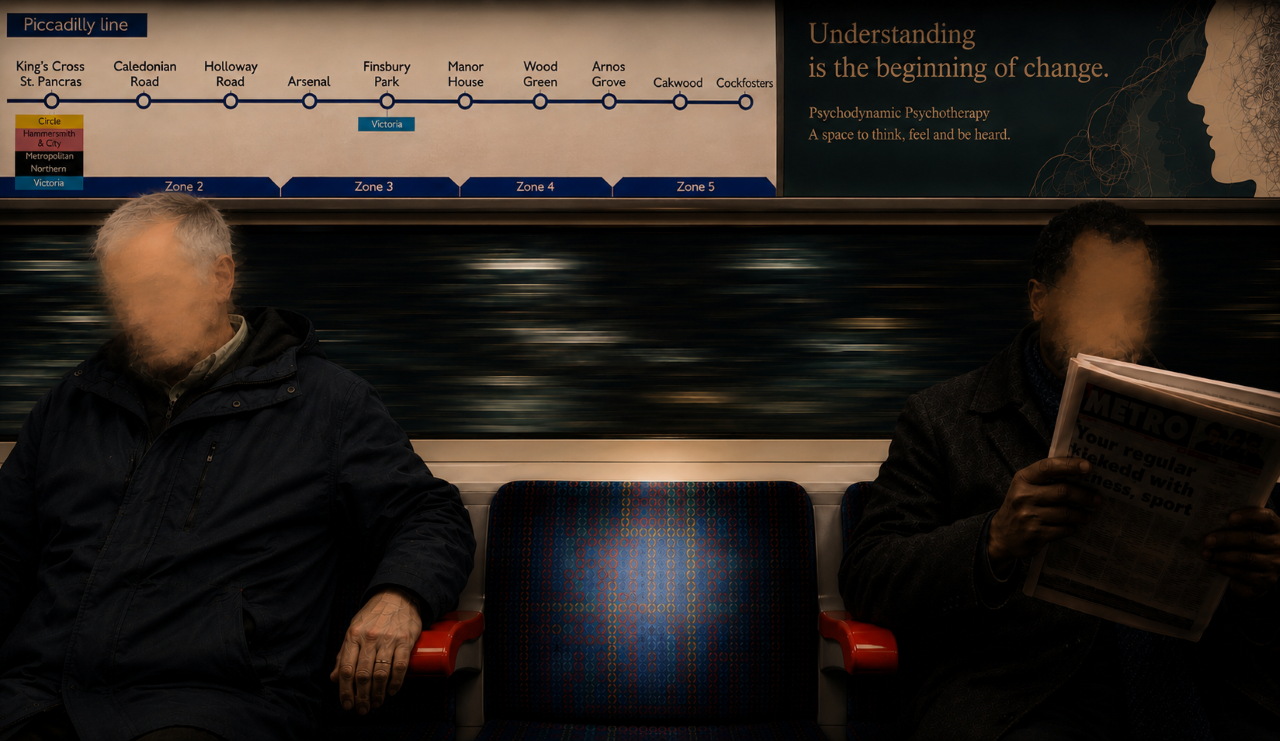
Many years ago, travelling home on the London Underground, I took a photograph of an empty chair.
At first glance, the image seemed entirely unremarkable. Two men sat on either side of the seat. One read a newspaper; the other stared quietly ahead. Above them hung part of the Piccadilly line map. Through the window, the darkness of the tunnel rushed past. Nothing dramatic was happening. Yet I never forgot the photograph.
For a long time, I assumed it was simply an interesting composition. The symmetry was pleasing. The chair sat neatly between the two passengers. Perhaps that was all. But the explanation never quite settled. Something about the image stayed with me in a way that felt disproportionate to its simplicity.
What struck me then — and continues to strike me now — is that the photograph was not empty at all. Two passengers occupied the frame, and beyond them were all the unseen travellers elsewhere in the carriage. The train carried hundreds of people across London. Yet my attention fixed on the one unoccupied space. I remember feeling a faint tug of curiosity, as though the empty chair were quietly asking to be noticed.
The psychoanalyst Harry Guntrip spent much of his career thinking about people whose lives appeared full from the outside. They worked, maintained relationships, carried responsibilities and participated fully in the world around them. Yet many described a persistent sense that something remained disconnected within them — not missing from their lives, but missing from themselves.
Guntrip became interested in what he called the hidden self: parts of a person that remain protected, withdrawn or unexpressed, often long after the circumstances that required such protection have passed.
There is another reason the image continues to interest me. The photograph itself no longer exists in any practical sense. It sits somewhere on an old phone that no longer works, buried amongst countless other forgotten pictures I can no longer access. If I wanted to look at it today, I couldn’t. And yet the image remains. Not perfectly. I’m sure the lighting has shifted in my mind. The expressions on the men’s faces have probably softened or blurred. Small details have undoubtedly faded. But the empty chair remains strangely clear. Of all the elements that might have disappeared, it is the unoccupied space at the centre of the image that has endured.
That, I think, is what first drew me toward Guntrip’s ideas. He was interested in the parts of ourselves that remain present even when they are difficult to see directly. The hidden self is not lost or destroyed. It simply exists outside our usual awareness, quietly shaping how we experience ourselves and the world.
The connection, however, is not that the chair represents the hidden self. Looking back, I am less interested in the chair itself than in what my noticing of it may have revealed. The scene was full — passengers, movement, destinations, purpose. Everything appeared occupied. Yet my attention settled on the one space that was not.
This is where the photograph and Guntrip’s thinking seem to meet. He became preoccupied with a question that sits at the heart of much of his work: can a life appear full while something essential remains disconnected from it? Many of the people he wrote about were participating fully in the world, yet privately sensed that important parts of themselves remained withdrawn or unexpressed. The chair did not symbolise that hidden self. Rather, it prompted the same question.
The original photograph may be inaccessible, yet something of it survives — not as a perfect record, but as an impression that has endured.
The train completed its journey years ago. The two men stepped off and continued with their lives. Whatever occupied their thoughts that day has almost certainly been forgotten. The newspaper was discarded. The journey ended.
Yet the picture remains clear in my mind. Perhaps it was never really about the chair. Perhaps it was about noticing an unoccupied space within a scene otherwise full of life — and recognising, even then, that such spaces have a way of asking to be understood. Or perhaps, after all these years, I am still trying to answer the same question that first made me lift my phone and press the button.
About Therapy with Alexis
If this piece has prompted reflection, you may be interested in learning more about psychodynamic counselling and the way I work.
Psychodynamic therapy is less concerned with quick answers and more interested in understanding. Together, we explore thoughts, feelings, relationships and patterns that may sit just outside of immediate awareness, often revealing connections between present difficulties and earlier experiences.
I offer individual psychodynamic counselling both online and in person. New clients are welcome to arrange a free 30-minute initial assessment, providing an opportunity to discuss what brings you to therapy and whether this way of working feels right for you.
References
Guntrip, H. (1992) Schizoid Phenomena, Object Relations and the Self. London: Karnac Books